
Caravan Stabiliser Legs








About this collection
Caravan stabiliser legs, corner steadies, stands and setup gear
Stop the van rocking every time someone moves
Parked on its wheels and jockey wheel alone, a caravan bounces when the kids climb into bed and sways when the wind gets up. Stabiliser legs brace the chassis corners and take that give out of the springs and tyres. They don't level the van: level it on its wheels first, then wind the legs down until they just bear weight. The grid opens with the legs and stands: the AL-KO 840 mm drop-down for tall and off-road chassis, X-Bull 440 to 560 mm drop-downs in pairs or sets of four, Manan galvanised drop-downs, Fiamma stack jacks that need no fitting, and side-wind jack stands for camper trailers and canopies. After them come the ramps, chocks, tyre savers and jacks that go down first. Below the grid you'll find how to measure for length, pick a load rating and set up without bending a leg.
-
Tall or off-road chassisAL-KO 840 mm drop-down corner steady
AL-KO's longest drop-down: 610 mm folded, 840 mm open, with a wide Big Foot base. Sold singly, so you can replace one leg or fit all four. -
All four corners in one boxX-Bull set of 4 drop-down legs, silver
440 to 560 mm, rated 1,200 lb a leg, two handles included. Also in black. -
Just the back cornersX-Bull drop-down legs, pair
The same 440 to 560 mm leg in a pair with one handle, in black or silver. -
Nothing to fitFiamma Stakka jacks, set of 4
UV-resistant plastic stands rated 750 kg each that adjust in height from about 31 cm. They live in a locker, not under the van. -
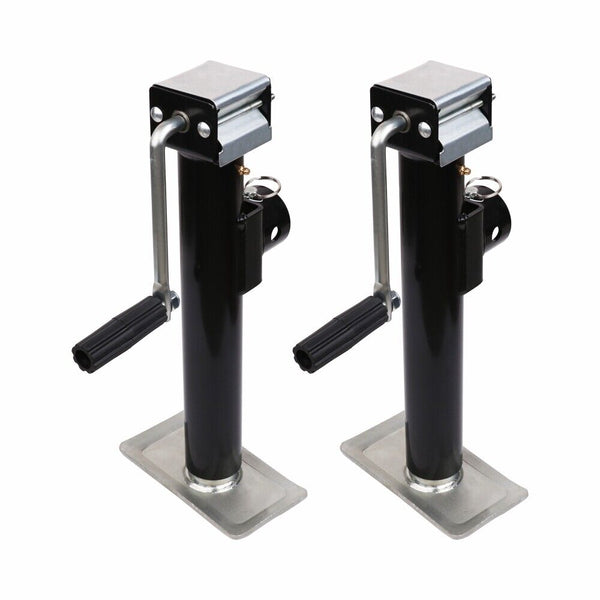
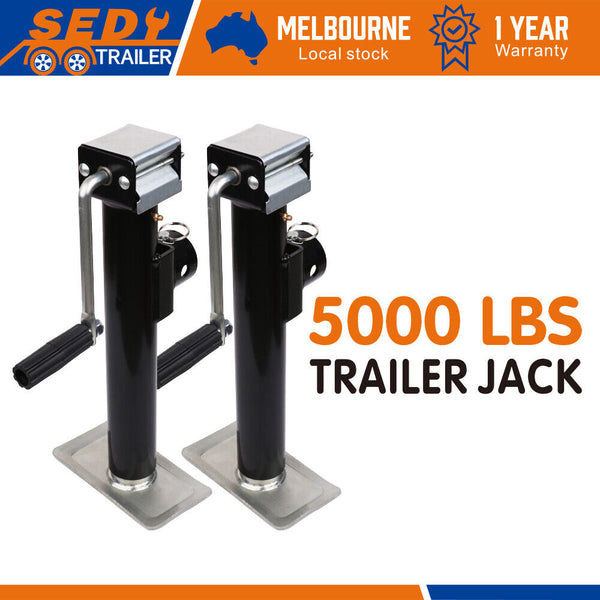
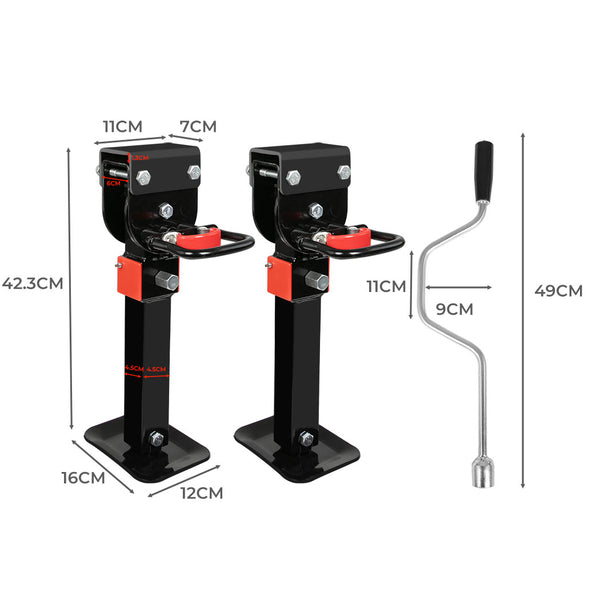
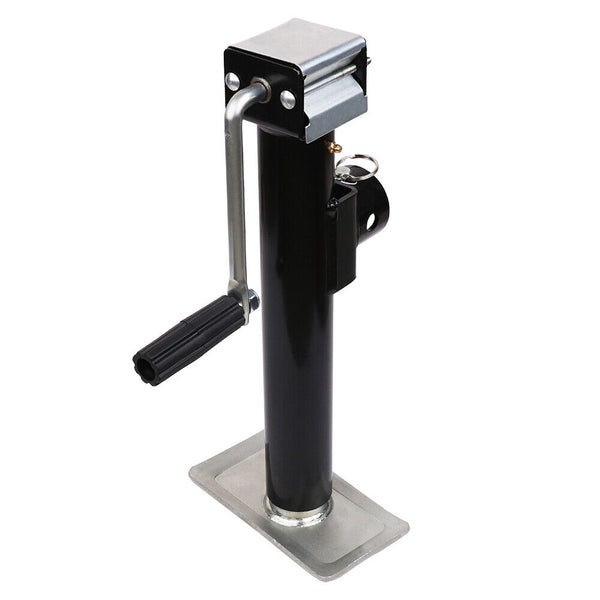
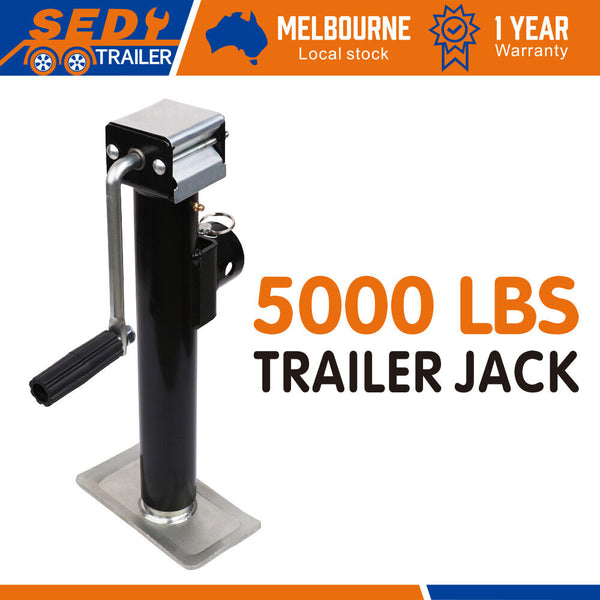
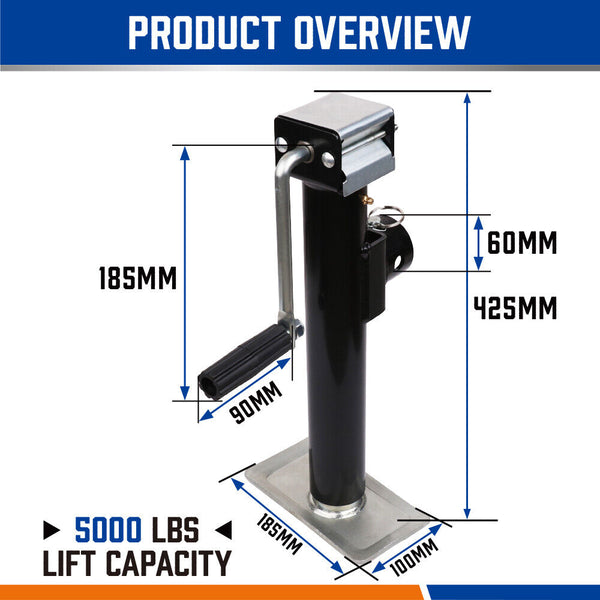
Camper trailers and canopiesSide-wind jack stands, pair
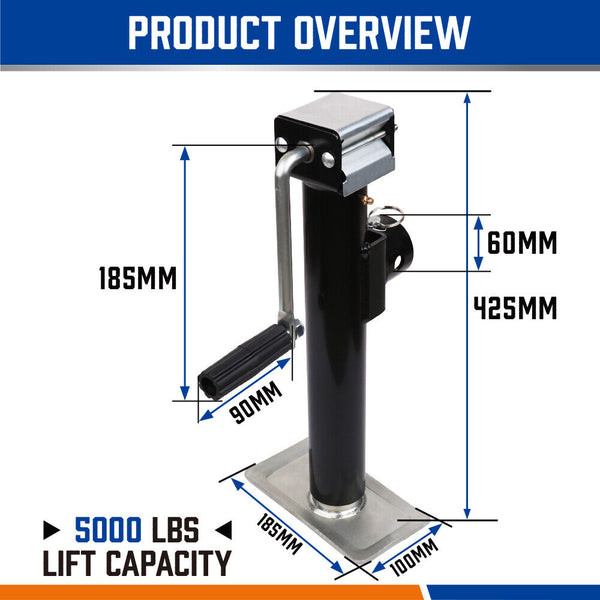
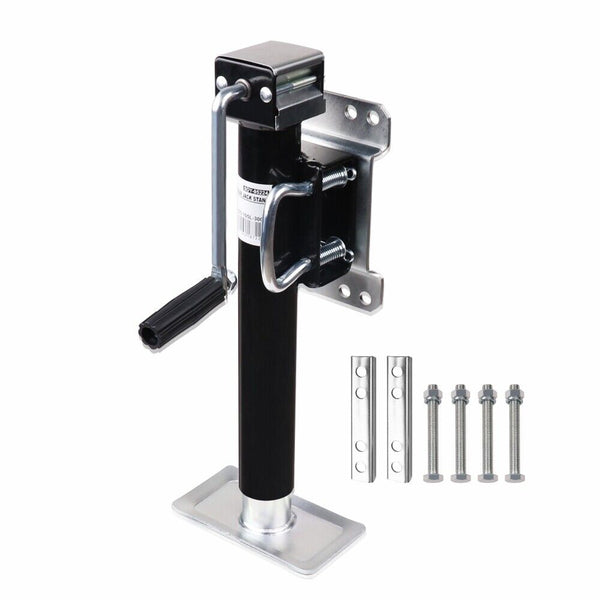
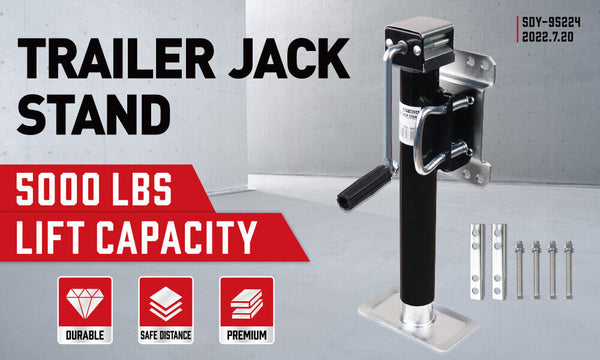
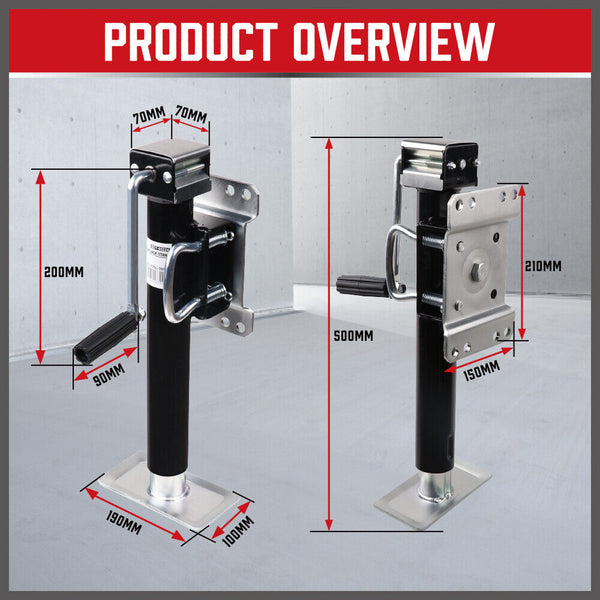
5,000 lb (2,267 kg) each, 425 mm closed to 685 mm extended, with a foot plate and a weld-on bracket. -
Level it firstMilenco Quattro levelling ramps, pair
Up to 160 mm of lift and 1,500 kg per wheel, so the legs only ever brace. Rated 5 out of 5 by the buyers who have reviewed them.
Caravan stabiliser leg guide
Choosing, fitting and using caravan stabiliser legs
Good legs are cheap insurance for a good night's sleep. What matters is buying legs long enough for your chassis and strong enough for your van, then fitting them where they can do their job. This guide covers why stabilising is not levelling, every type of stabiliser on the market, the legs and stands we carry side by side, what buyers say about the setup gear, how to measure, how many legs you need, what the load ratings mean, and the setup routine that keeps legs straight for years.
1. Stabilising is not levelling
This mistake bends more legs than any other. A stabiliser leg is a brace, not a jack. It is there to stop movement, not to lift the van.
- Levelling means getting the floor flat. For side to side, drive one wheel up onto a levelling ramp. For front to back, raise or lower the jockey wheel. A bubble level on the floor or a benchtop tells you when it's right.
- Stabilising comes next. With the van level and the wheels chocked, wind each leg down until its foot meets the ground and takes a firm share of the load. That stops the springs and tyres flexing as people walk around inside.
Lift a low corner with a stabiliser leg and that corner's whole weight sits on a screw thread and a pivot that were never sized for it. The leg can bow, the mounting can crack and the chassis rail can twist. AL-KO is blunt about it: its corner steadies are not designed to jack or lift a van, only to steady one that is parked.
2. The main types of caravan stabiliser legs
Most stabilisers fit one of six groups. Each braces the van, but they mount and work differently. We stock three of them today, and we say plainly below which ones we don't.
Drop-down corner steadies
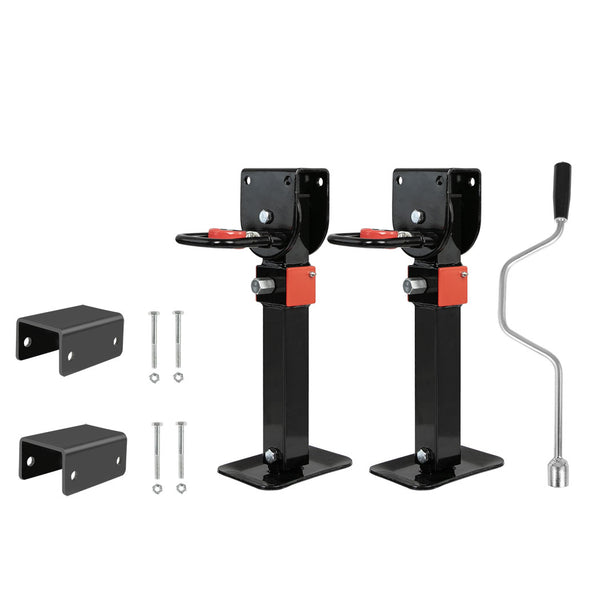
The usual choice on Australian vans. The leg bolts or welds under the chassis and swings down from a pivot. You set the angle, then a hex-drive screw extends the foot to the ground. For travel it winds up and swings back flat under the rail. We carry the AL-KO 840 mm, the X-Bull 440 to 560 mm legs and the Manan 410 to 545 mm pair.
Portable stands and stack jacks
Loose stands you place under the chassis at camp. Nothing is fitted to the van, so they suit motorhomes, hired vans and owners who would rather not drill or weld. We carry the plastic Fiamma Stakka jacks in a set of four.
Jack-leg stands
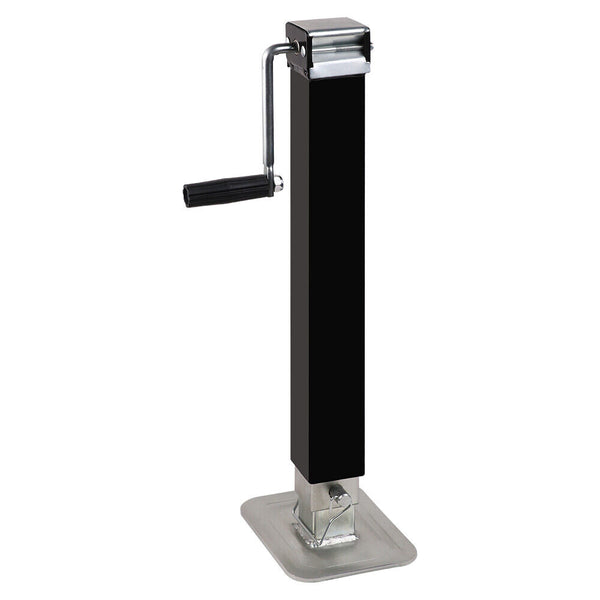
Heavy-duty side-wind jacks with a foot plate, built for trailers, camper trailers and slide-on canopies. They carry far higher ratings than corner steadies, and swivel versions turn up out of the way for towing. We carry a pair of side-wind stands, single stands and a tall square-tube stand with a drop leg.
Wind-down (scissor-style) corner steadies
The traditional steady. It is a folding frame bolted flat under the chassis, and turning the screw pushes the leg down until it meets the ground. There is no pin to pull and no angle to set, and it stows very flat. We don't list wind-downs at present. If you are replacing one like for like, send us the part number through the contact form and we will check what we can source.
Wheel-mounted stabilisers and stabiliser feet
Fold-flat devices that sit against the tyres. Some wedge between the wheels of a tandem axle and lock with a ratchet. Others are feet that pin or clamp against a single tyre. They stop the wheels rolling and take some flex out of the tyres, and they fit in seconds with no tools. They can't stop the overhang behind the axle bouncing the way corner legs can, so treat them as an extra, not a replacement. We don't sell this type at present. The nearest thing we carry is a tyre saver, which gives each tyre a solid base but doesn't clamp it.
Electric and hydraulic legs
Motor-driven legs run from a switch or remote, sometimes tied to an auto-levelling system on large vans and motorhomes. They are fast and easy on the back, but they cost far more, add weight and need power. We don't sell these.
3. The stabiliser legs and stands we stock, side by side
AL-KO figures come from AL-KO's own product pages. Every other figure comes from our product listings. The grid above shows today's price and stock for each one, and some of the single stands and the Manan pair sell out between deliveries.
| Product | Type | Reach | Rating | Pack | Fixing and finish |
|---|---|---|---|---|---|
| AL-KO 840 mm drop-down with Big Foot | Drop-down | 610 mm folded, 840 mm open | Not published by AL-KO | Single | Bracket and bolts included; zinc plated |
| X-Bull pair, black / silver | Drop-down | 440 to 560 mm | 1,200 lb per leg | 2, with 1 handle | Weld, with or without the mounting plate; electrophoresis-coated steel |
| X-Bull set of 4, black / silver | Drop-down | 440 to 560 mm | 1,200 lb per leg | 4, with 2 handles | As above |
| Manan pair, black or silver | Drop-down | 410 to 545 mm | 1,200 lb (545 kg) per leg | 2 | Weld-on; galvanised steel; hex drive |
| Fiamma Stakka jacks | Portable stand | From about 31 cm | 750 kg each | 4 | None; UV-resistant plastic |
| Side-wind jack stands, pair | Jack-leg stand | 425 to 685 mm | 5,000 lb (2,267 kg) each | 2 | Weld bracket; galvanised under black powder coat |
| Side-wind jack stand, single | Jack-leg stand | 425 to 685 mm | 5,000 lb (2,267 kg) | 1 | As above |
| Swivel jack leg stand, side handle | Jack-leg stand | 350 to 610 mm (foot to middle of bracket), 270 mm travel | 5,000 lb (2,267 kg) | 1 | Swivel bracket with pull pin; 190 x 100 mm foot |
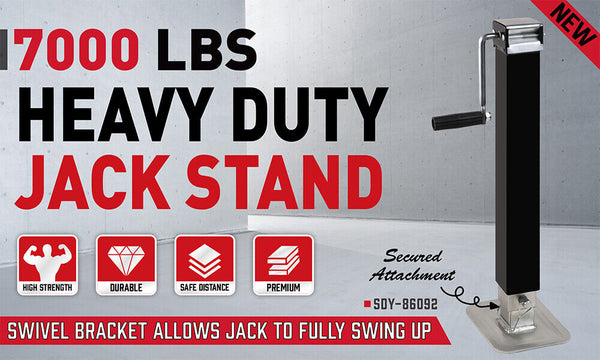
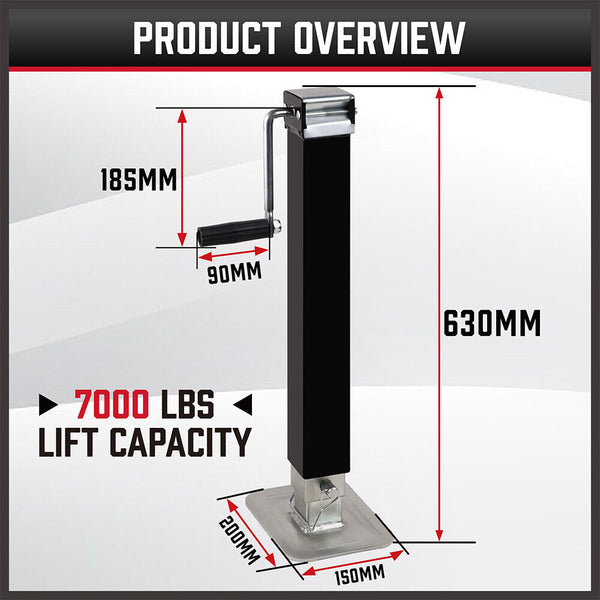
| Square-tube jack stand with drop leg | Jack-leg stand | 63 to 133 cm overall | 7,000 lb (about 3,175 kg) | 1 | Weld-on; 20 x 15 cm foot plate |
Which one? For a typical on-road van with corners around 450 mm off the ground, the X-Bull and Manan legs are the right length. For a tall, lifted or off-road van, the AL-KO 840 has the reach, and because it is AL-KO it matches the drop-downs many Australian vans leave the factory with. If you can't or won't fit anything, the Fiamma jacks do the job from a locker. The jack stands are for camper trailers, canopies and trailers that sit on their legs, not for bracing a caravan's corners.
We hold only a few Fiamma jacks at a time. If a listing shows no stock, ask through the contact form when more are due.
4. What buyers say about the setup gear
These are reviews left by customers on our product pages, word for word. Our stabiliser legs haven't been reviewed yet, so we show the setup gear that goes down before them instead of inventing anything.
"Sturdy and the extra height makes these the best levellers on the market"
"They work very well, seem very sturdy"
"A very solid piece of kit and will do the job of saving my caravan tyres as it is parked for long periods of time on a bricked driveway."
"Look great and good price and turned up in a timely manner"
Bought legs from us? Leave a review on the product page. It helps the next family choose the right length.
5. Handles, feet and spare parts
Small parts go missing more often than legs wear out. A winder gets left on the grass at the last camp, a foot cracks on a rock, a pull pin stops springing back.
- Handles come in the box with X-Bull. The X-Bull legs come with their own handles: one with each pair and two with each set of four. The Manan pair has a hex drive and a pull handle for swinging the leg up and down.
- Check the drive before you buy a spare winder. Most drop-downs use a hex drive. A slotted jockey-wheel crank won't fit, and hex sizes differ between makes. A cordless drill with a matching hex socket is a good backup, used gently (see setting up).
- Keep the winder with the chocks. Keep the handle in the same locker as your ramps and chocks so it is never the thing left behind.
- Turning a worn foot over. The X-Bull foot plate can be flipped 180 degrees, so a scuffed face can be turned to the ground.
- Replacing one leg. If a single leg is bent, replace it rather than straighten it, and match the length and mounting of the others. The AL-KO 840 is sold singly for exactly this.
- AL-KO winders, Big Foot bases, pins and brackets. We don't list these separately yet. Send us the part number stamped on your leg, or a photo, through the contact form and we will check what we can supply.
6. The setup kit that goes with the legs
Legs only work on a van that is already level and chocked, so the grid also carries the gear that goes down first. We keep these in stock for that job.
| Product | What it does | Key figures |
|---|---|---|
| Milenco Quattro levels, pair | Four-step ramp that cradles the wheel at each height, so no separate chock is needed | Up to 160 mm lift; 1,500 kg per wheel; carry case |
| Milenco wedge levels, pair | Classic wedge ramp with a grippy leading edge | 1,000 kg per wheel |
| Milenco T1 mini levels, pair | Compact two-step ramp for small corrections | Steps of 3 and 7 cm; 1,250 kg each |
| Milenco wedge level with chock | One wedge plus a wide chock with side handles | 1,000 kg per wheel |
| Milenco wedge level chock | Spare chock to match the wedge levels | 10 x 10.5 x 15.5 cm |
| Camco curved leveller and chock | Curved ramp that doubles as a chock; stackable | Use one per side, a pair per side on a tandem |
| Coast RV 3-step levelling ramps, pair | Three-step HDPE ramps with chocks and a bag | 5,000 kg per pair |
| Milenco Stacka tyre savers, twin pack | A solid base under each tyre on soft ground or gravel, and against flat spots when the van is stored | 1,500 kg per wheel |
| Trail-A-Mate hydraulic jockey wheel and jack kit | Hydraulic jockey wheel that converts to a jack with the base plate supplied | 1,000 kg working load; 2,900 kg ATM |
| Coast RV Gator 12 V drawbar jack | Electric jockey jack that clamps to the A-frame, for setting the front-to-back level | 1,800 kg; 355 mm lift |
Shop the full range of wheel chocks and levelling ramps and jockey wheels and jacks for more sizes.
7. Manual or electric legs?
For most family vans, manual legs are the sensible buy. Electric legs earn their keep on heavy vans and motorhomes, and for owners who find winding hard on the back or knees.
| Manual (hand wind or hex drive) | Electric or hydraulic | |
|---|---|---|
| Setup time | A few minutes to get around all four corners | Seconds, from a switch or remote |
| Effort | Kneeling at each corner and winding | Little or none |
| Power | None needed | Needs a healthy 12 V supply |
| Weight | Light, a few kilograms a leg | Heavier, with motors and wiring |
| What can go wrong | Seized threads, worn pivots and lost handles, all cheap to fix | Motors, switches and wiring, which usually need a specialist |
| Cost | Low | Much higher than manual legs |
The easy way to take the work out of manual legs is a cordless drill with a hex socket, used gently. If it's the winding at the front that wears you out, an electric drawbar jack such as the Gator takes over that end, while the corner legs stay manual.
8. How to measure for stabiliser legs
The number that matters is the gap from the underside of the chassis rail, where the leg will mount, to the ground. Measure it properly before you buy.
- Park the van on flat, hard ground such as a driveway, loaded roughly as you travel.
- Level it with the jockey wheel so the floor is flat front to back.
- At each corner where a leg will go, measure straight down from the underside of the chassis rail to the ground. Note all four figures. They often differ, especially in front of and behind the axle.
- Compare those figures with the leg's reach. The leg should touch the ground with plenty of thread still in reserve, well short of the end of its travel.
Allow for sloping sites. A flat driveway is the easy case. Once you level the van on a slope, its low corners sit further off the ground. If your driveway figure is already near the top of a leg's range, the first sloping campsite will run you out of thread. Choose legs whose longest reach is well beyond your flat-ground figure, or carry a block to stand the foot on.
Check the folded length too. A drop-down leg has to fit between its mount and the ground at its shortest. The X-Bull starts at 440 mm, the Manan at 410 mm and the AL-KO 840 folds to 610 mm. On a low van, a leg that is too long folded can't be set upright.
Worked example. Suppose your rear corners measure about 420 mm from rail to ground on the driveway. A 440 to 560 mm X-Bull leg, set at a slight angle, reaches with well over 100 mm to spare for a slope. If the same corner measures 550 mm, the X-Bull and Manan would be near full stretch before you leave home. The AL-KO 840 is the better choice there: it folds to 610 mm, so set it at an angle and it covers that gap with plenty of thread left.
Lifted and off-road vans. Raised suspension, bigger tyres and chassis lifts all widen the gap, so off-road vans often need the longest steadies that will fit. On camper trailers and canopies, a side-wind jack stand that extends to 685 mm, or the square-tube stand that reaches 133 cm overall, covers the height.
Ground clearance when stowed. Check the other direction too. A stowed leg hangs below the rail by its own depth. On a low van, or one that tackles speed humps, creek crossings and steep driveways, make sure the stowed leg isn't the lowest point.
9. How many legs does a caravan need?
Four, one near each corner of the chassis, is the standard setup and how most vans leave the factory. The jockey wheel at the front gives a fifth point of contact.
- Single-axle vans pivot over one axle, so they rock front to back more easily. Legs at all four corners matter most on these.
- Tandem-axle vans sit more firmly on their wheels, but the overhang behind the rear axle still bounces, so four corner legs are still the norm.
- Long vans and big family vans sometimes add a fifth and sixth leg near the middle of the body, under the bed or by the door, where people move most. A set of portable stands such as the Fiamma Stakka jacks lets you try this before you fit anything.
- Camper trailers and canopies usually run two to four jack-leg stands, depending on how heavy the body is and whether the trailer is unhitched.
Buying a set of four, such as the X-Bull set, keeps every corner the same length and rating. If you are replacing one damaged leg, match the length of the others so the van sits evenly.
10. Load ratings: what the numbers mean
Stabiliser legs are rated in pounds more often than kilograms. There are about 2.2 lb to the kilogram, so a 1,200 lb leg is good for about 545 kg.
On a van that is set up properly, the wheels and jockey wheel carry most of the weight and the legs only take a firm share. The rating is your safety margin for the extra loads: people moving around, the van leaning in a gust, someone climbing in the door at the corner. A simple check is to add up the ratings of all your legs and compare the total with your van's ATM (the most it may weigh fully loaded, shown on the compliance plate). The total should be comfortably above the ATM.
For example, four 1,200 lb X-Bull or Manan legs add up to roughly 2,180 kg, a sensible margin for a light to mid-weight van. AL-KO doesn't print a load figure for its corner steadies. It designs them to brace a parked van, not to carry it, so use them that way. Fiamma rates each Stakka jack at 750 kg, so a set of four totals 3,000 kg.
Jack-leg stands are a different class. Our side-wind pair is rated at 5,000 lb each and the square-tube stand at 7,000 lb, which is why stands like these suit canopies and camper trailers that sit on their legs with the body lifted clear.
Ratings on ramps and wheel bases work the other way: they are given per wheel. A ramp rated 1,500 kg per wheel, like the Quattro, covers a caravan of up to about 3,000 kg on two wheels.
11. Feet, pads and soft ground
A leg is only as steady as the ground it stands on. On bitumen or a concrete slab, any foot will do. On grass after rain, sand, red dirt or a soft gravel pad, a small foot presses in slowly overnight, and by morning the van rocks again.
- Wide feet help. AL-KO's Big Foot, fitted to the 840, is a round base that spreads the load. The X-Bull legs have a 16 x 12 cm base, and the square-tube jack stand a 20 x 15 cm plate.
- Put a pad under the foot. A square of hardwood or thick plywood, or a purpose-made plastic jack pad, spreads the load over a much bigger area. It should be wider than the foot and sit flat on the ground.
- Use a block to save thread. On a sloping site, a block under the low-side legs means they don't have to extend as far.
- Don't forget the wheels. If the tyres sink into soft ground, the whole van drops and the legs go slack. Stacka tyre savers give each tyre a solid base, and the Quattro ramps have a solid underside for the same reason.
- Avoid anything that cracks or rolls. Bricks and stones can split or shift under load. Loose rocks can skate out from under the foot.
- Check the next morning. On soft sites, give each leg a quarter turn after the first night if the van has started to move.
12. Should stabiliser legs be straight or angled?
A leg that leans slightly outward braces the van better than one that drops straight down. Think of a camera tripod. Splayed legs resist tipping in every direction, while legs straight underneath mainly stop up-and-down bounce. An outward lean helps against the side-to-side sway you feel in wind and when people walk the length of the van.
How you set the angle depends on the leg. AL-KO drop-downs swing from flat to set angles, including straight down, and lock at each one. The Manan legs swing to 9 positions. The X-Bull legs are different: their 9 adjustable angles belong to the rotating base plate, which turns so the foot sits flat on the ground whatever angle the leg ends up at. A flat foot grips better and doesn't dig in at one edge.
Whichever leg you have, set all four to a similar angle, with the feet a little outside the line of the chassis. Don't push the angle to the limit. A very shallow leg loads the pivot sideways and loses height.
13. Quick-release pins, handles and locking
Drop-down legs are held in their travel and working positions by a pin, released with a pull handle. The X-Bull legs have a quick-release handle with a soft grip, and the Manan pair has a pull handle for raising and lowering. However it is built, the routine is the same:
- Pull the handle to free the leg from its travel position.
- Swing the leg down to the angle you want and let go. Wiggle the leg to make sure the pin has dropped back in and it is locked at that angle.
- Only then wind the foot down. A leg that isn't locked can fold under load as soon as the van moves.
- To pack up, wind the foot fully up first, then pull the handle, swing the leg flat and check it has locked in the travel position.
If a pin sticks, clean and lightly oil it rather than forcing it with a hammer. A pin that no longer springs back, or a cracked pull handle, is a cheap part to replace. Ask us for the part by number.
14. Setting up and packing up, step by step
Setting up:
- Position the van and chock the wheels.
- Level side to side on ramps, then front to back with the jockey wheel.
- Swing each drop-down leg down and lock it at its angle (see pins and locking).
- Put a pad or board under each foot if the ground is anything but hard.
- Wind each leg down until the foot touches, then a little more until it feels firm. Work diagonally, front left then rear right, so you don't twist the van.
- Stop as soon as the leg is firm. If the bubble on your level moves, you have gone too far.
- Walk around the van once to check every leg.
About drills. Plenty of owners wind their legs with a cordless drill and a hex socket. It works, but a drill on full power can't feel the leg take weight and can strip a thread, shear a pin or bend the leg before you notice. Use the lowest clutch setting, keep the speed down, and do the last few turns by hand with the winder.
Packing up: wind every leg fully up, swing it back to its travel position and check it is locked. Then walk slowly around the van before you move. Driving off with a leg down is one of the most common setup mistakes, and one of the most expensive. A pack-up checklist on the back of the door helps.
15. Fitting legs: bolt-on or weld-on
Corner legs mount under the chassis rail near each corner, in front of and behind the wheels. Before you start, check what else is under the van. Water tanks, grey tanks, gas lines, plumbing and wiring often share that space.
- The AL-KO 840 comes with a mounting bracket and bolts. Fit the bracket to the chassis rail, then hang the leg from it. If your van already has AL-KO drop-downs, measure the old bracket before you order so the new leg lines up.
- X-Bull and Manan legs are made to weld on. The X-Bull can go straight to the chassis or through its uncoated mounting plate. If the chassis is galvanised, the weld area needs proper preparation and cold-gal paint afterwards or it will rust. Have a qualified welder do it.
- Bolt-on in general. Use high-tensile bolts and lock nuts, and re-check them for tightness after the first few trips.
- Check your warranty. Some van and chassis makers have rules about welding to or drilling the chassis. Ask before you modify a newer van.
Jack-leg stands mount differently. The side-wind pair and single stand come with a weld-on bracket, which suits a camper trailer drawbar or a canopy frame, and the side-handle stand has a swivel bracket with a pull pin so it turns up for towing. Portable stands like the Fiamma Stakka jacks need no fitting at all.
16. Rust, coatings and looking after your legs
Legs live under the van in road spray, dust and, near the coast, salt. The finish matters.
- Zinc plating is the standard AL-KO finish and handles normal touring well. Keep an eye on it after salt exposure.
- Electrophoresis (E-coat) is an electro-applied paint finish, used on the X-Bull legs. It protects well as long as stone chips don't break through to bare steel.
- Galvanised steel is what the Manan legs are made from, and our side-wind jack stands add black powder coat over the galvanising. These are the toughest of the common finishes.
- Plastic stands, such as the Fiamma Stakka jacks, can't rust. They live in a locker rather than under the van anyway.
After a beach trip or a dirt road, hose the legs down. Every few months, grease the screw thread and pivots lightly, oil the pull pins, and wind each leg through its full travel so nothing seizes. Touch up stone chips with paint before rust takes hold. A leg that has bent, or that wobbles at the pivot, should be replaced, not straightened.
17. Brands and related gear
The legs, stands and setup gear on this page come from AL-KO, X-Bull, Manan, Fiamma, Milenco, Camco, Trail-A-Mate and Coast RV. For the rest of the chassis and setup gear:
- Wheel chocks and levelling ramps
- Jockey wheels, jacks and stabilisers, including the AL-KO 10" solid-tyre jockey wheel for heavier vans
- All caravan parts and caravan accessories
For the whole routine from arrival to bedtime, read our guide to setting up camp and the full caravanning checklist.
Our take
Measure before you buy, and buy for your worst campsite, not your driveway. If you are fitting legs from scratch and can weld, a set of four X-Bull drop-downs covers most on-road vans, handles included. If your van sits high or goes off-road, or already runs AL-KO drop-downs, the AL-KO 840 gives you the reach and a Big Foot as standard. If you can't fit anything, the Fiamma Stakka jacks do the job from a locker.
Spend as much care on the levelling gear and the feet as on the legs. A good pair of ramps such as the Milenco Quattros means the legs only ever brace and never lift, and a board under each foot stops them sinking. Level on ramps first, wind the legs down only until they are firm, and check they are all up before you drive away.
Caravan stabiliser leg FAQs
What are caravan stabiliser legs?
They are short adjustable legs fitted near the corners of a caravan's chassis, or stands placed under it. Once the van is level, you wind them down to the ground so the van stops bouncing on its springs and tyres when people move around inside or the wind picks up.
Can I use stabiliser legs to level my caravan?
No. Level the van first with ramps under the wheels and the jockey wheel at the front, then lower the legs until they are firm. Lifting a corner with a stabiliser leg can bend the leg or damage its mounting, and AL-KO says its corner steadies are not designed to lift a van.
How do I measure for caravan stabiliser legs?
Level the van on flat, hard ground, then measure from the underside of the chassis rail to the ground at each corner where a leg will mount. Choose a leg whose reach covers that figure with plenty to spare for sloping sites, and whose folded length still fits under the rail.
What is the difference between drop-down and wind-down corner steadies?
A drop-down leg swings down from a pivot and locks at an angle, then a screw extends the foot. A wind-down steady is a folding frame that the screw pushes down to the ground on its own. Drop-downs give more reach and an angled brace, while wind-downs are simpler and stow flat.
How many stabiliser legs should a caravan have?
Four, one near each corner, is the standard. Long or heavy vans sometimes add a pair in the middle, near the bed or the door, where people move most.
What load rating should my stabiliser legs have?
Add up the ratings of all your legs and make sure the total comfortably exceeds your van's ATM, which is shown on the compliance plate. Ratings are often given in pounds, and 1,200 lb is about 545 kg. Some makers, AL-KO among them, don't publish a figure because their steadies are designed only to brace a parked van.
What should I put under caravan stabiliser legs?
A flat, solid pad that is wider than the foot, such as a plastic jack pad or a square of hardwood or thick plywood. It spreads the load so the foot doesn't sink into grass, sand or dirt. Avoid bricks and loose stones, which can crack or slide.
Should caravan stabiliser legs be straight or angled?
Angled slightly outward. Like a tripod, splayed legs resist sideways sway as well as bounce. Keep the angle moderate and similar on all four legs, and make sure the foot sits flat on the ground.
How do quick-release stabiliser legs lock?
A pin holds the leg in its travel position and at each working angle. Pull the handle to free the leg, swing it to the angle you want, let the pin drop back in and check the leg is locked before you wind it down. Wind it fully up before you release it to stow.
Can I use a drill to wind down stabiliser legs?
Yes, with care. Use a low clutch setting and a slow speed, stop when the leg makes contact, and do the final turns by hand. A drill at full power can strip the thread or bend the leg.
I've lost the winder handle for my legs. What should I do?
Check the drive type first, because hex and slotted ends are not interchangeable and hex sizes differ between makes. X-Bull legs come with their own handles. For AL-KO or another brand, send us the part number or a photo of the leg through the contact form and we will check what we can supply.
Are wheel-mounted stabilisers as good as corner legs?
Not on their own. Stabilisers that wedge between or against the tyres stop the wheels rolling and firm up the tyres, but they don't brace the ends of the van, so the overhang can still bounce. They work best alongside corner legs.
Do I need to weld stabiliser legs to my caravan?
Not always. The AL-KO 840 bolts on with its own bracket. Weld-on legs such as the X-Bull and Manan are the strongest fixing and should be fitted by a qualified welder, with the weld area painted afterwards. Check your van maker's warranty rules first.
Are portable caravan stands as good as fitted legs?
They do the same job without fitting anything. They take a little longer to place at each camp and need room to carry, but they suit motorhomes, hired vans and vans you don't want to modify.
What is the difference between a stabiliser leg and a jack stand?
A stabiliser leg braces a caravan that is already sitting on its wheels, so it carries only a share of the weight. A jack stand is built to hold a camper trailer, canopy or trailer up on its own, so it carries a much higher rating, often 5,000 lb or more, and uses a side-wind handle.