
Measure your van's overall length — drawbar tip to rear bumper, including the spare wheel and bike rack — then buy the cover bracket that your measurement falls inside. Never round down. For most Australian owners a breathable, UV-stabilised cover in the $130–$250 range is enough for seasonal storage; spend $350–$700 only if the van lives outside year-round in full sun.
The two mistakes that cost people money are measuring the body instead of the overall length, and fitting a cover over a dirty van.
A caravan cover is one of the few pieces of gear where getting the size wrong doesn't just disappoint you — it actively damages the thing you bought it to protect. A cover that's too big flogs in the wind and sands the clearcoat off your van's corners. One that's too small leaves the rear wall exposed to the sun that killed it in the first place.
This guide covers the decisions that actually change the outcome: how to measure, what the price difference between a $130 cover and a $600 one really buys, which materials survive an Australian summer, and how to fit and store a cover so it lasts more than one season. Prices and stock shown throughout are pulled live from our range.

How to measure your caravan for a cover
Cover sizes are sold in length brackets — 14–16 ft, 18–20 ft, and so on. You need one number to shop with, and it is not the number on the manufacturer's spec sheet. Van makers usually quote body length. Covers are sized on overall length.
- Park on level ground. On a slope the drawbar sits low and you'll read the length short.
- Run a tape from the very tip of the drawbar to the furthest point at the rear. That means the coupling at the front, and the spare wheel, bumper bar or bike rack at the back — whichever sticks out most.
- Measure the maximum width at the widest point, usually the awning rail or the wheel arches.
- Measure the height from the ground to the top of the tallest roof item — air conditioner, solar panels, TV aerial, hatch.
- Convert to feet if you measured in metres. One metre is 3.28 ft, so a 6.1 m van is 20 ft.
- Write down anything that protrudes and note where it sits. You'll need to pad these before the cover goes on.
If your measurement lands on or near a bracket boundary, go up, not down. A 20 ft van sits at the top edge of an 18–20 ft cover and the bottom of a 20–22 ft one. The 20–22 will fit; the 18–20 will strain at the corners, wear through at the seams and may not reach the bottom of the rear wall.
The exception: don't jump two brackets to "be safe". Excess fabric is what flaps, and flapping fabric is an abrasive.
Height and width matter less than length for fit, but they matter for coverage. A tall van with a rooftop air conditioner uses up more of the cover's fabric going over the top, which pulls the skirt higher up the walls. If your van is unusually tall for its length, size up.
Find the cover that fits your van
Enter your length and van type — we'll show only the covers that actually fit, with live prices and stock.
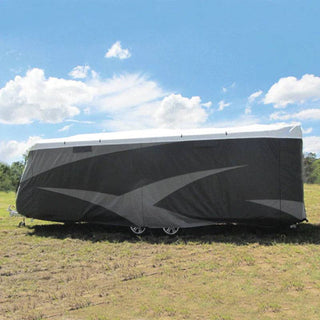
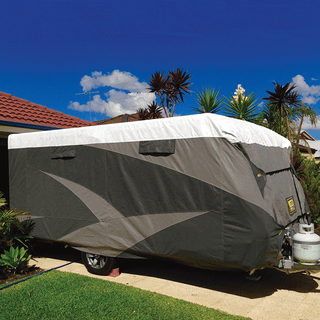
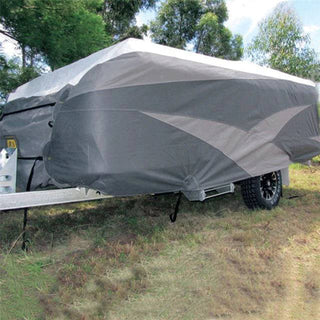
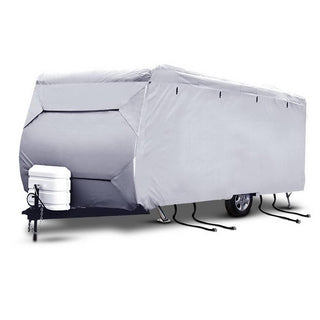
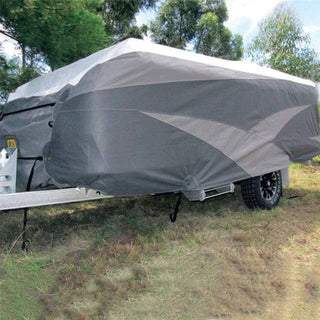
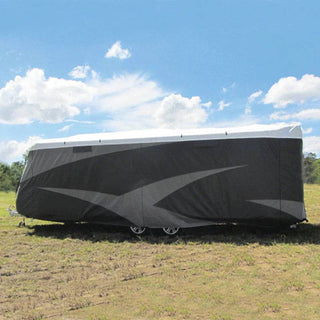
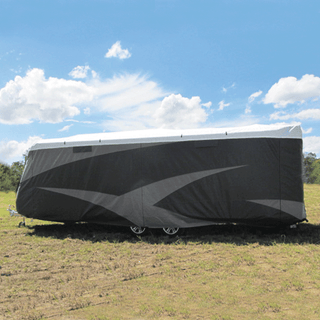
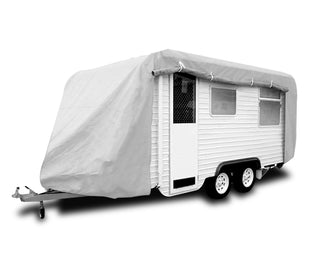
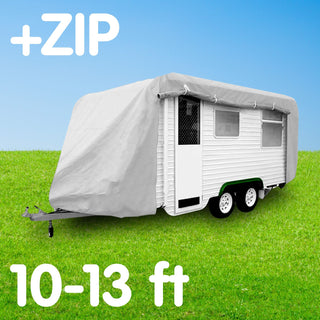
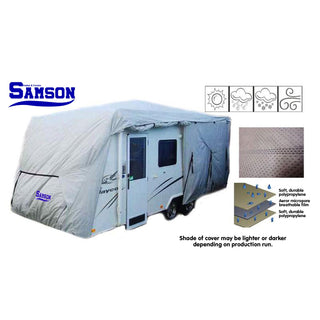
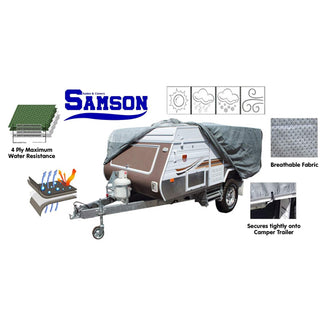
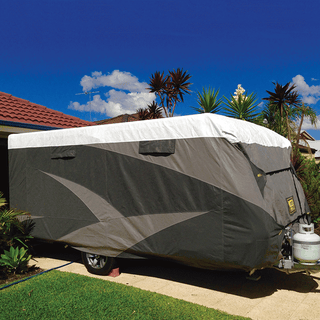
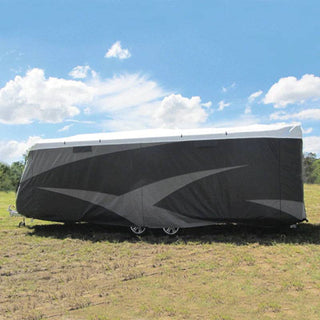
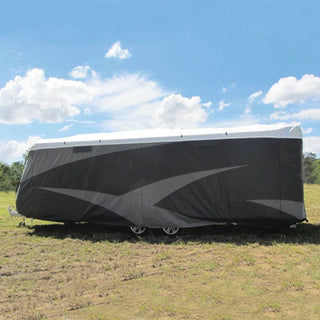
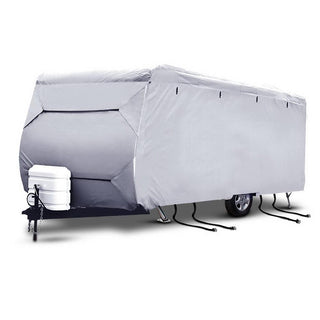
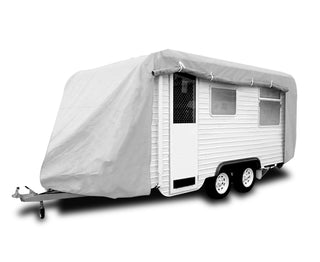
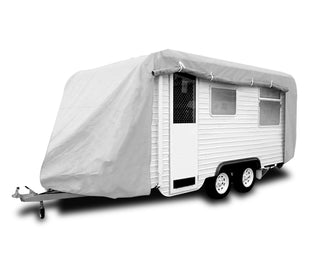
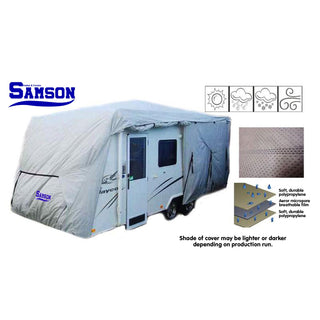
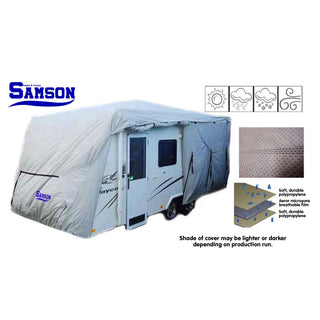
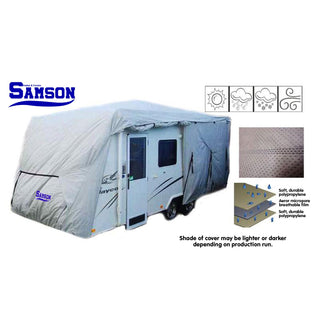
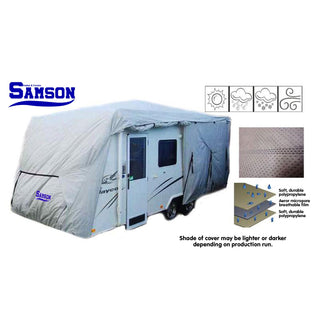
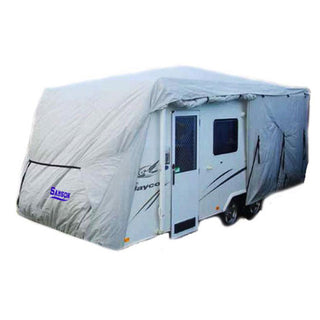
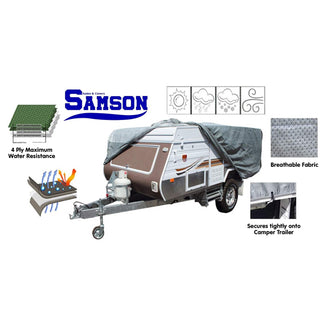
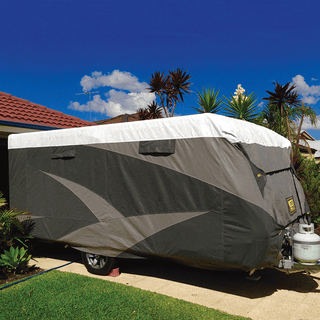
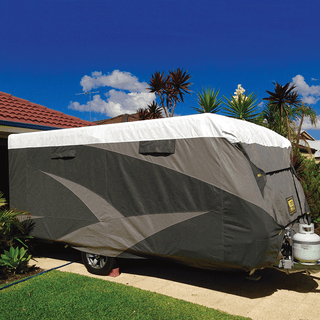
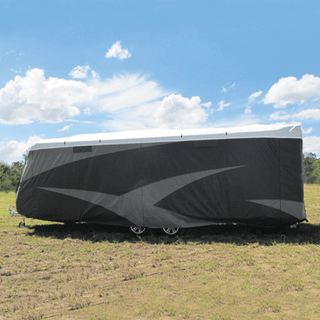
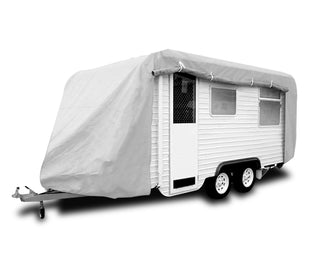
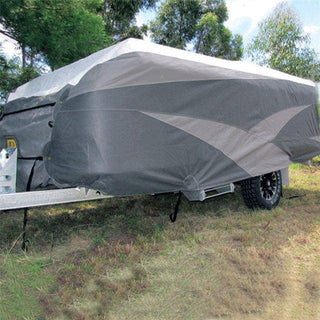
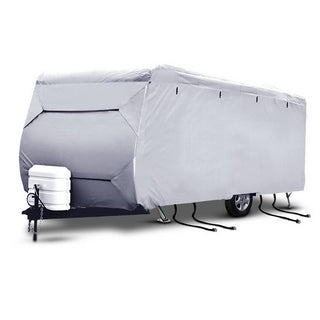
No cover in stock matches that length yet. Browse all 31 covers or ask us to source one.
Measure bumper to drawbar tip, then round up to the next bracket.
See all 31 coversCover materials, compared honestly
Nearly every caravan cover sold in Australia is a woven synthetic — the differences are in how many layers, how the fabric is treated, and how well it breathes. Breathability is the specification that matters most here, and it's the one buyers skip.
A fully waterproof, non-breathable cover is worse than no cover at all. Moisture always gets underneath — from condensation, from a damp van, from ground evaporation — and a sealed cover traps it against the walls. That's how you get mould on the seals, milky window plastics and a musty interior.
| Material | Typical price | Best for | The trade-off |
|---|---|---|---|
| Four-layer polypropylene | $130–$150 | Seasonal and occasional storage. Light enough for one person to fit. | Thinner fabric. Expect a few seasons rather than a decade in full sun. |
| Coated polypropylene, 300d weave | $200–$245 | Year-round driveway storage. Reflective outer, softer inner face. | Heavier to throw over a tall van on your own. |
| Olefin HD (premium) | $345–$695 | Vans stored outside permanently, high-UV inland and northern sites. | Two to four times the entry price. |
| Canvas | Not stocked | Extreme abrasion resistance, e.g. heavy tree litter. | Heavy, absorbs water, and will grow mould if it's ever packed away damp. |
Canvas gets recommended a lot in older buying guides. For most Australian owners it's the wrong choice — the weight makes it a two-person job every time, and wet canvas left folded in a locker is the fastest route to a ruined cover. We don't stock it for that reason.
What the extra money actually buys
The jump from a $140 cover to a $500 one isn't mostly about waterproofing — all of them shed rain. It's about how long the fabric survives ultraviolet light, and how well the cover stays put in wind.
Entry tier — around $130 to $150
Four-layer polypropylene with an elasticated hem front and rear and adjustable tie-down straps that pass under the van. Breathable, comes with a carry bag. This is the right buy if the van is under a carport, stored for part of the year, or you're bridging to a shed.
Mid tier — around $200 to $245
A 300d UV-treated polypropylene weave with a super-reflective outer coating and a smoother inner face that's kinder to paint. The meaningful upgrade at this price is dual side zips — you can open a full panel and get into the van without dragging the whole cover off, and the cover can be fitted either way round to suit which side your door is on. Double-stitched seams throughout, quick-release clips on the underside straps.
Premium tier — around $345 to $695
ADCO's Designer Series, using Olefin HD fabric on current stock. These block 99.8% of UV, carry a three-year manufacturer's warranty, and have zippered side panels with eyelets so the panel doubles as a small awning when it's rolled up. Most models include a repair patch kit tucked into the storage bag. The caravan and pop-top models use a four-layer Olefin HD roof section that extends further down the front and rear — the two areas that fail first.
Work out what a repaint or a reseal costs on your van, then decide. If the van lives outside in Queensland, the Territory or inland WA, the premium cover pays for itself. If it's under cover eight months of the year, the entry cover is not a compromise — it's the correct product.
Universal fit or custom fit?
Almost everything sold in Australia is a bracketed universal fit — cut to a length range and shaped to a generic caravan profile, with elastic hems and underbody straps taking up the slack. This is what the covers in the size finder above are.
True custom covers are made to your van's exact model and are worth considering only in two cases: an unusual body shape that generic covers can't sit on, or permanent hard-mounted gear that a universal cover won't clear. Expect to pay considerably more and wait for manufacture.
For a standard caravan, pop-top, camper trailer or Class C motorhome, a correctly sized universal cover fits well enough that the difference isn't worth the money.
Features worth paying for
- Side access zips. The single feature most likely to determine whether the cover actually stays on. If getting inside means removing the whole cover, you'll stop putting it back.
- Adjustable underbody straps with quick-release clips. Straps are what stop the cover moving in wind. Clips are what stop you crawling under the van in the rain.
- Elasticated hem, front and rear. Pulls the skirt in under the van so wind can't get beneath and balloon the cover.
- Ventilation. Vents or breathable side panels let trapped moisture out. Non-negotiable in the tropics.
- Double-stitched seams and a reinforced skirt. Seams and the lower edge are where covers fail, because that's where they rub.
- A repair patch kit. A small tear patched early doesn't become a metre-long split in the next front.
Matching the cover to Australian conditions
Australia's UV levels are among the highest in the world, and UV — not rain — is what destroys both caravans and the covers protecting them. Everything else is regional.

- High-UV inland and northern regions (Queensland, the Territory, inland WA and SA): UV stability is the whole game. This is where a premium cover's rated UV block earns its price, and where a cheap cover will chalk and go brittle within a couple of summers.
- Tropical and subtropical wet seasons: prioritise breathability and ventilation over waterproof ratings. Humidity under a sealed cover causes more damage than the rain it's keeping off.
- Coastal storage: salt-laden air corrodes fittings and etches windows. A cover helps, but rinse the van before the cover goes on — sealing salt against the paint is worse than leaving it open.
- Hail belts (south-east Queensland, much of NSW): a fabric cover softens small hail and stops paint pitting. It will not save you from a severe storm. Don't buy one expecting armour.
- Dusty inland sites: dust is abrasive. Fit only over a clean van, and check the straps after every windy stretch.
- Under trees anywhere: sap, bird droppings and leaf litter stain and etch clearcoat. A cover is the cheapest defence there is.
You'll see American-made covers marketed for snow loading. That specification is real, but it's aimed at the northern-hemisphere market. Unless you store in the alpine areas of Victoria, NSW or Tasmania, it isn't a reason to choose one cover over another here.

Fitting and removing a cover without damaging your van
More paint damage is caused by covers fitted badly than by covers not fitted at all. Four rules:
- Wash and dry the van first. Grit trapped under a cover becomes sandpaper the moment the wind moves the fabric. This is the number one cause of cover-related paint damage.
- Never fit over a wet van. Even a breathable cover can't clear that much moisture, and you'll find mould on the seals.
- Pad every sharp protrusion. Aerials, corner brackets, gutter ends, ladder rungs, the tow coupling. Foam pipe lagging or an old towel taped in place is enough. These are what wear holes in a cover from the inside.
- Tension the straps properly, then re-check. A cover should be snug enough not to move in a stiff breeze. Re-tension after the first windy day — everything settles.
Fit from front to back, working over the roof from a stable ladder, and unroll rather than drag. Dragging is how covers get torn on the first fit.
Looking after the cover
A cover is a consumable, but it doesn't have to be an annual one.
- Wash with cold or warm water, mild soap and a soft brush. No detergents with solvents, no bleach, no pressure washer — pressure drives water through the coating and destroys breathability.
- Never machine wash or tumble dry unless the manufacturer specifically allows it. Check the instructions supplied with your cover; they vary between brands.
- Dry it completely before it goes in the bag. A cover packed away damp will be mouldy in a fortnight, and mould stains don't wash out.
- Store the bag somewhere cool and dry, off a concrete floor.
- Patch small tears as soon as you spot them. Wind turns a 20 mm nick into a 500 mm split in one night.
The advice you'll sometimes read to "keep the cover out of direct sunlight" applies to storage only. Sitting in the sun over your van is the job. A cover that can't handle sunlight is a cover that has failed.
ADCO caravan covers: the range we sell most of
ADCO is the cover we recommend most often and the one most people here end up buying, so it is worth explaining what you are paying for rather than just listing it.
The ADCO Designer Series is an American RV cover line built for high sun exposure, high moisture and long-term storage. Current stock uses Olefin HD fabric, and the specification that matters in Australia is the UV figure: the fabric is UV-stabilised and blocks 99.8% of the sun's damaging UV rays. Every ADCO cover in our range carries a three-year manufacturer's warranty, which is the longest we stock.

What you actually get
- Zippered side panels. On the caravan and pop-top models there are zippered panels along one side, so you can get into the van without pulling the cover off. The panels have eyelets, so a rolled-up panel doubles as a small awning.
- A four-layer Olefin HD roof section that extends further down the front and rear — the two areas most exposed and the first to fail on a cheaper cover.
- A repair patch kit on most models, with patches for both the top and side material, tucked into a pocket in the storage bag.
- Breathable throughout, so condensation and ground moisture can escape instead of sitting against the walls.
Which ADCO model fits your van
ADCO is sized by vehicle type as well as length, so pick the model line first, then the length bracket:
- Caravan covers — 14–16 ft up to 24–26 ft
- Pop Top covers — 12–14 ft up to 18–20 ft, cut for the lower profile of a collapsed pop-top
- Camper Trailer covers — 10–12 ft up to 14–16 ft
- Class C Motorhome covers — 20–23 ft up to 26–29 ft, using the Olefin HD fabric
ADCO covers in stock now
If your van is stored outside year-round, yes — the UV rating and the three-year warranty are what you are buying, and they are the two things that decide whether a cover lasts one summer or several. If the van lives under a carport or only comes out seasonally, a Weisshorn or Wallaroo cover is the sensible buy and we will tell you so.
The other brands we stock
Wallaroo — the all-rounder
UV-treated polypropylene in a 300d weave, with a super-reflective outer coating and a smooth protective inner face. Dual-zipped on one side so you can access the interior with the cover on, and fittable either way round to suit your door. Double-stitched seams throughout, elasticised hem front and rear, adjustable underside straps with quick-release clips, carry bag included.
Weisshorn — the value pick
Four-layer covers with UV, water and dust protection, breathable to prevent moisture build-up, with reinforced elasticated hems, adjustable tie-down straps and a carry bag. Sized for caravans and campervans across the common brackets. The right buy for seasonal storage.
Camec
A composite build — water-resistant roof section, breathable weather-resistant side panels, ventilation flaps, and a heavy-duty reinforced skirt with elasticised hems front and rear. Rated against acid rain, industrial pollutants, tree sap, bird droppings and dust. Availability is limited; check the size finder above for current stock.
Warranties, and what they actually cover
Cover warranties run from one to three years, and the longest in our range is ADCO's three-year manufacturer's warranty. What they cover is materials and workmanship — seam failure, coating delamination, hardware breaking. What they don't cover is the thing most likely to happen: abrasion and tearing caused by a cover that was the wrong size, fitted over a dirty van, or left loose in the wind.
That's worth knowing because it changes what you should optimise for. Buying the right bracket and fitting it properly protects you more than any warranty term does.
Five mistakes that cost people a cover
- Measuring body length, not overall length. The drawbar and spare wheel can add over a metre. This is the most common return we see.
- Buying oversized "to be safe". Loose fabric flaps, and flapping fabric abrades paint and destroys itself.
- Fitting over a dirty or wet van. Grit sands the clearcoat; trapped moisture grows mould.
- Choosing waterproof over breathable. Sealed covers trap condensation against the walls.
- Packing it away damp. The cover survives the season, then dies in the locker.
Frequently asked questions
What size caravan cover do I need?
Measure the overall length of your van from the tip of the drawbar to the furthest point at the rear, including the spare wheel and any bike rack, then choose the bracket your measurement falls inside. If you land on a boundary, size up one bracket rather than down. A 20 ft van should take a 20–22 ft cover, not an 18–20 ft one.
Do caravan covers damage paint?
Only when they're fitted wrongly. Damage comes from grit trapped between the cover and the van, or from a loose cover moving in the wind. Wash and dry the van before fitting, pad any sharp protrusions, and tension the underbody straps so the cover can't shift. Done properly, a cover protects paint rather than harming it.
Are caravan covers waterproof?
Good covers are water-resistant and breathable rather than fully sealed, and that's deliberate. A completely waterproof cover traps condensation and ground moisture against the van, which causes mould on seals and rubbers. You want a cover that sheds rain while still letting water vapour escape.
Can I leave a caravan cover on all year?
Yes, provided the cover is breathable and UV-stabilised, and you check it periodically. Re-tension the straps after windy weather, look over the seams and corners every couple of months, and take the cover off occasionally on a dry day to air the van. If the van lives outside permanently, buy for UV resistance rather than price.
How much does a caravan cover cost in Australia?
Entry-level four-layer covers start around $130 to $150. Mid-range covers with side zips and reflective coatings run about $200 to $245. Premium covers for permanent outdoor storage range from roughly $345 up to $695 for large motorhome sizes. Live prices for every size are shown in the size finder above.
Will a caravan cover fit over my air conditioner and solar panels?
Generally yes, but measure your height to the top of the tallest roof item and factor it in. Rooftop gear uses up cover fabric going over the top, which lifts the skirt higher up the walls. Pad any sharp edges — aerial bases and panel corners are a common cause of holes worn from the inside. If your van is tall for its length, size up one bracket.
Is a universal or custom fit caravan cover better?
For a standard caravan, pop-top, camper trailer or motorhome, a correctly sized universal cover fits well enough that a custom cover isn't worth the extra cost or wait. Custom covers make sense only for unusual body shapes or permanently mounted gear that a generic cover can't clear.
How long should a caravan cover last?
It depends far more on UV exposure and fit than on brand. An entry-level cover on a van stored under a carport can last many seasons. The same cover in full inland sun, fitted loosely, may not see out two summers. Premium UV-stabilised covers are built for permanent outdoor use and carry warranties up to three years.
Are ADCO caravan covers worth the money?
If your van is stored outside year-round, yes. ADCO Designer Series covers are UV-stabilised and block 99.8% of UV, and they carry a three-year manufacturer’s warranty — the longest in our range. UV is what destroys both caravans and the covers protecting them, so that is the specification worth paying for. If your van is under a carport or only stored seasonally, a cheaper breathable cover does the job.
What is ADCO Olefin HD fabric?
Olefin HD is the fabric used on current ADCO Designer Series stock. It is UV-stabilised and breathable, blocking 99.8% of the sun’s damaging UV rays while still letting moisture vapour escape. The caravan and pop-top models use a four-layer Olefin HD roof section that extends further down the front and rear, which are the most exposed areas and the first to fail.
Do ADCO covers let you get inside the caravan?
Yes. ADCO caravan and pop-top models have zippered panels along one side that open for interior access without removing the cover. The panels have eyelets, so a rolled-up panel can double as a small awning.
What warranty do ADCO caravan covers come with?
Every ADCO cover in our range is backed by a three-year manufacturer’s warranty covering materials and workmanship. It does not cover abrasion or tearing caused by a wrong-sized cover, fitting over a dirty van, or leaving the cover loose in the wind.
The short version
Measure overall length, round up to the next bracket, and buy breathable. If the van is stored under cover for much of the year, an entry cover does the job. If it lives outside in the sun, buy for UV resistance and side-zip access — the covers people keep using are the ones that don't need to come off every time they want to get inside.
Common questions
How to measure your caravan for a cover?
Cover sizes are sold in length brackets — 14–16 ft, 18–20 ft, and so on. You need one number to shop with, and it is not the number on the manufacturer's spec sheet. Van makers usually quote body length .
Universal fit or custom fit?
Almost everything sold in Australia is a bracketed universal fit — cut to a length range and shaped to a generic caravan profile, with elastic hems and underbody straps taking up the slack. This is what the covers in the size finder above are.
What you actually get?
Zippered side panels. On the caravan and pop-top models there are zippered panels along one side, so you can get into the van without pulling the cover off. The panels have eyelets, so a rolled-up panel doubles as a small awning.