
Caravan Annexes













Caravan annexes: turn your awning into an extra room
A caravan annex closes in the space under your awning so it works as a second room: somewhere for the kids on a wet afternoon, a spare bed, a dining room out of the wind, or a place to keep boots and bikes. You don't need a full made-to-measure canvas annex to get there. Start with the awning you already have. A roll-out awning takes screens or a zip-on wall kit. A Fiamma cassette awning takes a Fiamma Privacy Room. A campervan takes a drive-away awning. All three are in the product grid above. Below is our guide to matching an annex to your awning, measuring for one and keeping it tight in wind and rain.
-
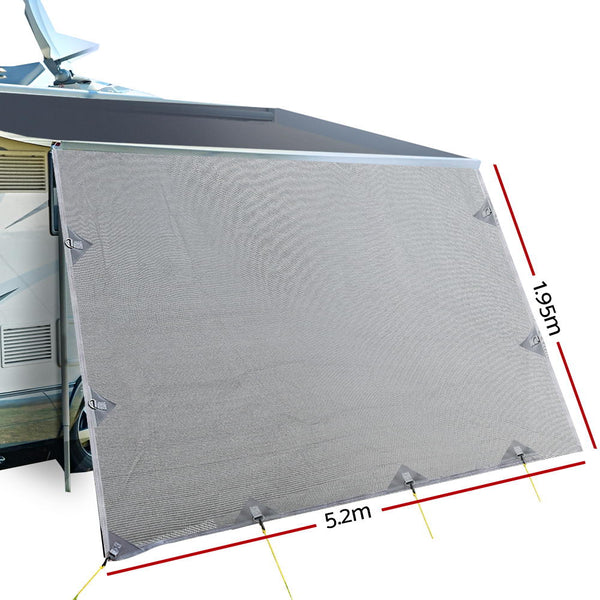
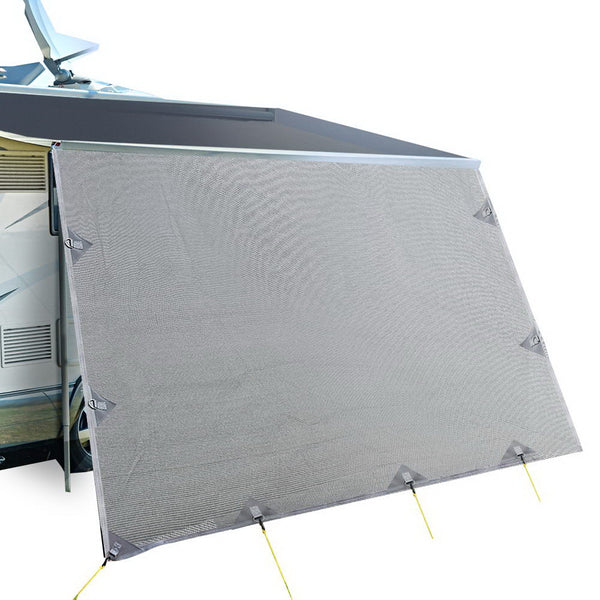
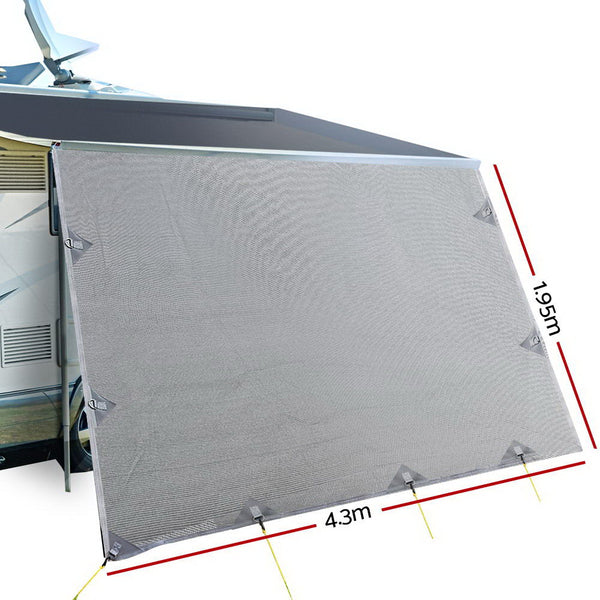
Cheapest privacy, roll-out awningWeisshorn 4.3 m privacy screen
Hangs off the front of the awning and pegs down. 95% shade rating, with pegs, guy ropes and a bag. -
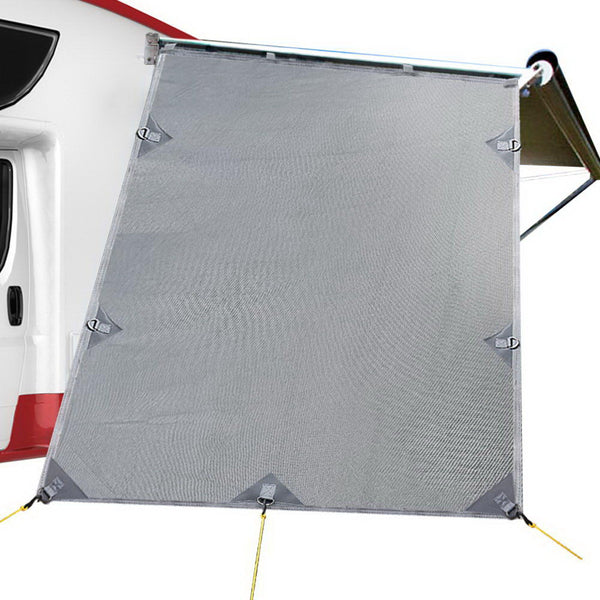
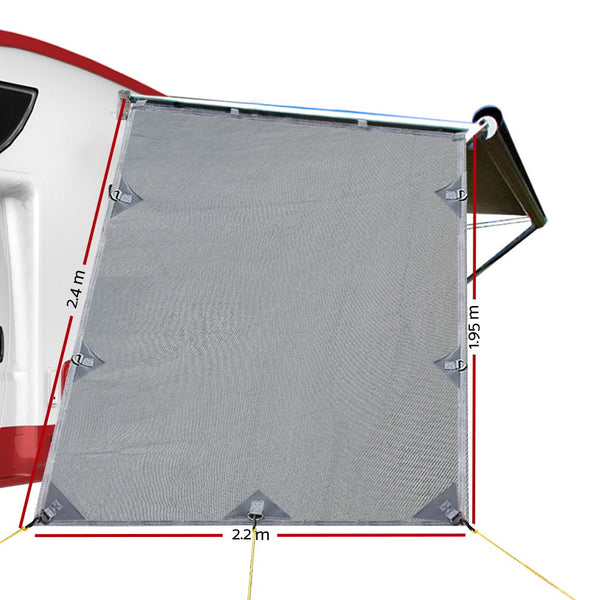
Close off either endWeisshorn 1.95 x 2.2 m end wall
Reversible, so it works on the left or right end. Buy two and add a front screen for a three-sided shade room. -
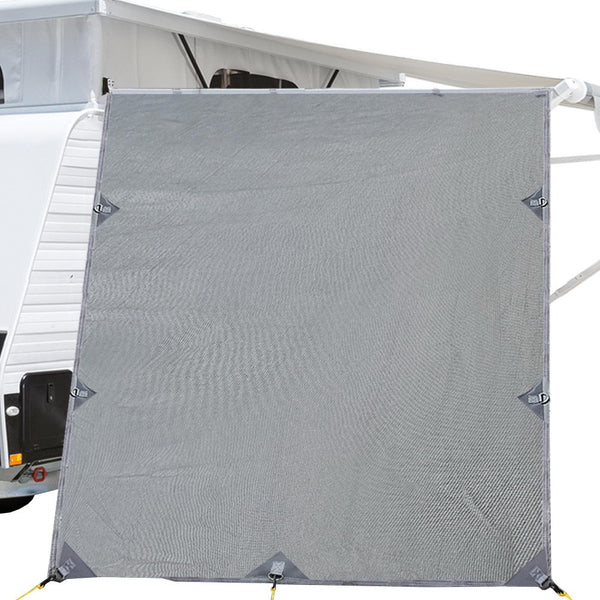
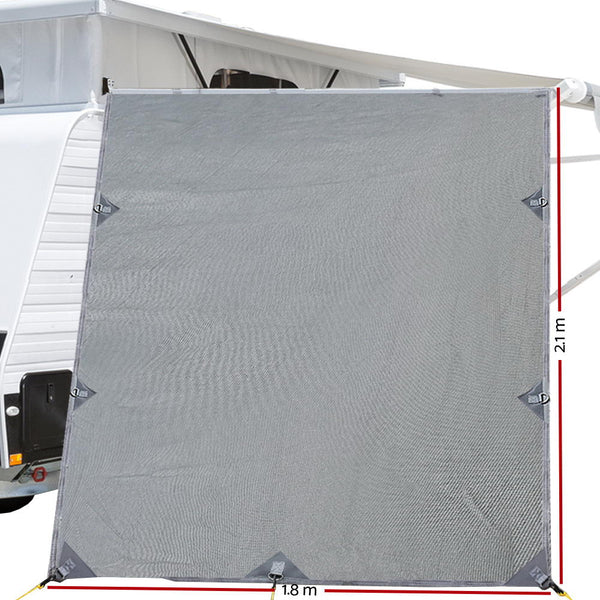
Pop-top with a roll-out awningBariloche pop-top screen, 2.1 x 1.8 m
Cut for the lower awning on a pop-top. Reversible, with 7 pegs and 7 guy ropes. -
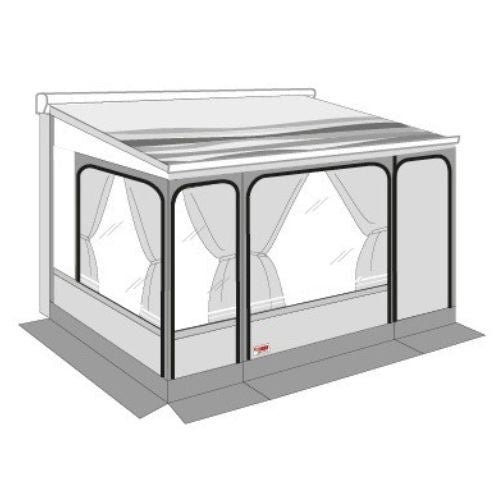
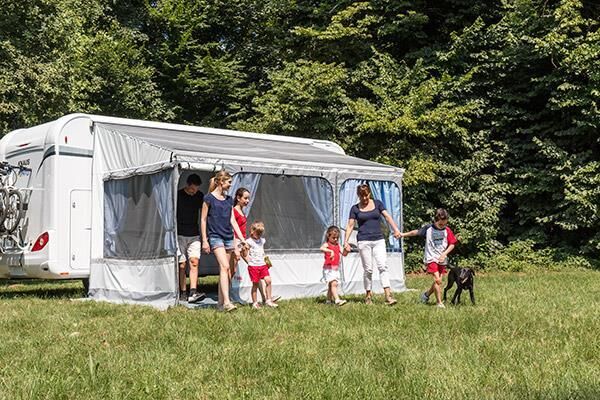
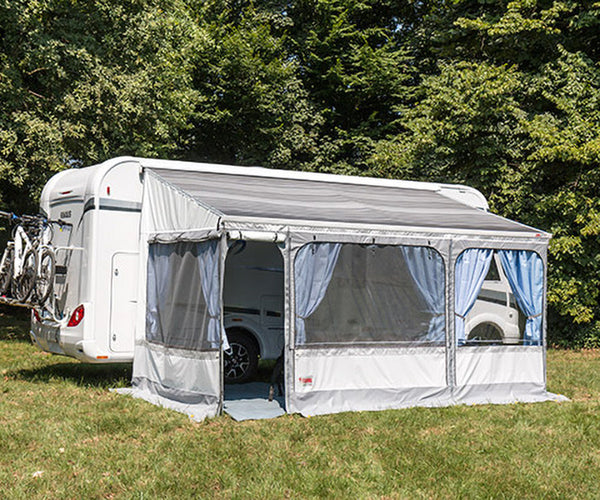
Fiamma F45 or F70 awningFiamma Privacy Room 300 Medium
Made by Fiamma for its own cassette awnings, for awnings 225 to 250 cm off the ground. The Large suits 251 to 280 cm. -
Campervan or van conversionVango Faros III Low
Free-standing drive-away awning for rail heights of 180 to 210 cm, with a sewn-in groundsheet. Leave it pitched and take the van out for the day. -
Full walls for an 18 ft roll-outCoast awning wall kit, 18 ft
Three walls, a door in each, flyscreened windows and a draught skirt. We hold very few, so check stock and lead time before you plan around it.
Choosing, measuring and pitching a caravan annex
The right annex depends less on brand than on the awning it hangs from and how long you stay in one place. This guide sorts out the names first, then walks up the options from a $50 screen to a full room, shows how to measure, explains how each type fixes to the van, and covers the parts people forget: anti-flap kits, floors, draught skirts, gas vents, wind and waiting times.
1. Annex, awning, privacy screen: what's the difference?
These words get mixed up all the time, in shops and at the campground. The difference matters because each one fits differently.
- Awning. The roof. It's the fabric that rolls or winds out from the side of the van on two arms or legs. On its own it gives shade and keeps the rain off the door, but it is open on three sides.
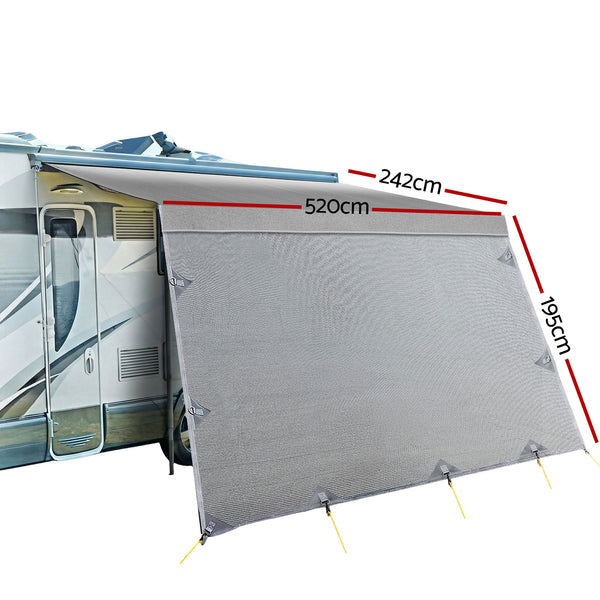
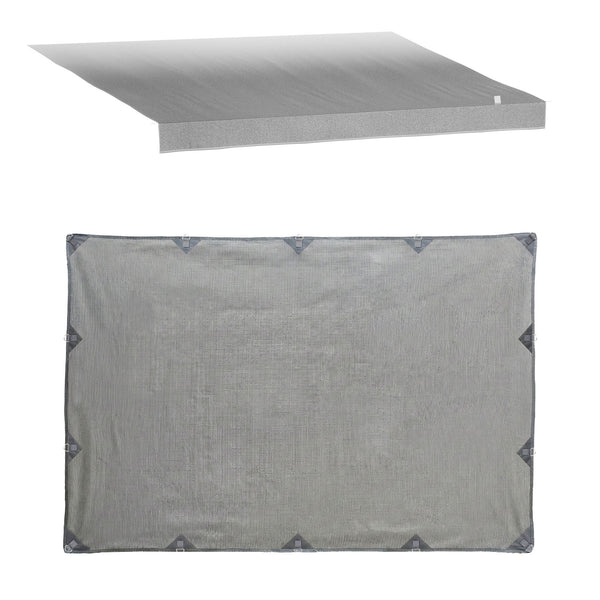
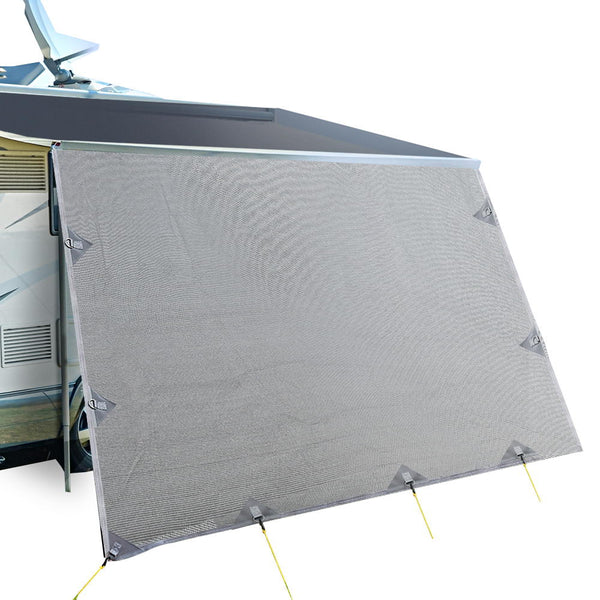
- Privacy screen (sunscreen). A single panel of shade mesh that hangs from the awning's front edge or one end and pegs to the ground. It cuts sun and stops people looking in, while air still moves through. It doesn't keep out rain or insects.
- Awning wall kit. Two end walls and a front wall that zip or clip together under an existing roll-out awning. You get a closed room with doors and windows, and the awning stays the roof.
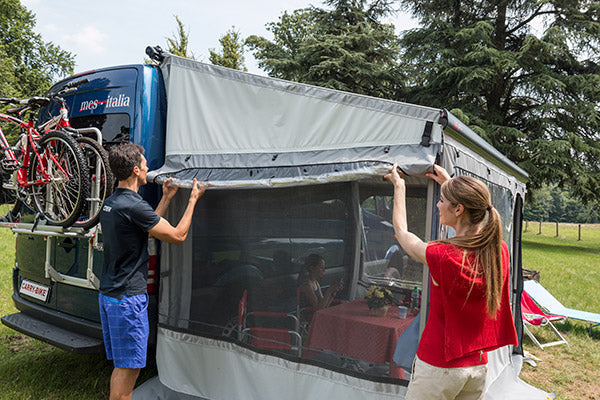
- Privacy room. The same idea built by an awning maker for its own awnings, such as Fiamma's Privacy Room for its cassette awnings. It is sized to that awning family and uses fittings made for it.
- Full annex. Usually a made-to-measure canvas or vinyl room with its own roof panel, sewn for one model of van. It is the most weatherproof choice. It also costs the most, weighs the most and is the slowest to put up.
- Drive-away awning. A free-standing tent-like room for campervans. It connects to the vehicle with a fabric tunnel, so you can unhook it and drive off for the day while it stays pitched.
When people search for a caravan annex, most of them want one of the middle three: something that turns the awning they already own into a room without buying a whole new canvas set.
2. Five ways to enclose an awning, cheapest first
Price bands below are what we charge across the range at the time of writing. They are rounded, so check the product page for today's price.
| Option | What you get | Price band | Best for |
|---|---|---|---|
| Privacy screens | Shade mesh panels for the front and ends of a roll-out awning | About $50 to $105 each | Summer trips, privacy on a tight site, shade without trapping heat |
| Awning wall kit | Three walls with doors, windows and a draught skirt, under your existing awning | About $2,000 (18 ft) | Roll-out awning owners who stay a week or more |
| Fiamma Privacy Room | Front and side panels made by Fiamma for its own cassette awnings, with windows, insect mesh and curtains | About $2,200 to $2,800 | Motorhomes and caravans with a Fiamma F45, F70, F65 or F80 |
| Drive-away awning | Free-standing room for a campervan, poled or inflatable | About $650 to $1,800 | Vans you want to drive away from camp |
| Made-to-measure annex | Canvas or vinyl room sewn for one model of van | Usually more than a wall kit | Long stays in cold or wet weather |
We don't sell made-to-measure annexes. They are built for specific van models, often to order. If that is what you need, ask the van's maker or a caravan trimmer, and allow for a wait (see stock and lead times).
3. Start with your awning
Every annex hangs off an awning, so the first job is to work out which kind you have. Look at the case along the van wall and at the legs.
Roll-out awning (most Australian caravans)
A fabric awning on a roller tube, held out by two arms that also act as legs, usually Dometic or Carefree. These are sized in feet. They take privacy screens, or the Coast awning wall kit for full walls.
If the fabric is tired or torn, replace it before you add walls. The Weisshorn 18 ft replacement fabric is 18 oz vinyl and comes bundled with a screen as fabric plus privacy screen.
Fiamma cassette awning (motorhomes, vans, some caravans)
The awning winds out of a hard case, and its legs drop from the front bar. Fiamma's Privacy Room is built for the F45s, F70 and F45L. Versions for the F65 and F80 suit Fiat Ducato-based vans and some caravans.
We stock the 300 Medium, the 300 Large and the 300 Ducato. See all of them in Fiamma privacy rooms.
Campervan with an awning rail or a wind-out awning
A drive-away awning connects with a kador (beaded) strip in the vehicle's rail. The Vango Faros III Low suits rail heights of 180 to 210 cm. The Magra Air VW is cut for VW-height vans. The twin drive-away kit fits both 4 mm and 6 mm rails. Browse campervan awnings or the Vango range.
No awning yet? Choose the awning first, then the annex. See caravan and motorhome awnings. If you want walls later, check which wall kits or rooms that awning can take before you buy it.
4. Measuring for an annex
Get three numbers before you shop: awning length, how far it reaches out, and how high it sits off the ground. Measure with the van levelled and the awning set the way you normally pitch it.
Length
Roll-out awnings are named in feet. Measure between the centres of the two arms, not just the width of the fabric. The fabric is a little shorter than the awning's name. Our 18 ft replacement fabric, for example, is 5.2 m wide. Fiamma awnings are named in centimetres (300, 350, 400 and so on). The Privacy Room comes as a 300 cm base room, with add-on front panels for longer awnings.
| Roll-out awning | In metres (approx.) | Screen to suit |
|---|---|---|
| 13 ft | 4.0 m | 3.7 m front screen |
| 14 ft | 4.3 m | 4.0 m screen for 14 ft |
| 15 ft | 4.6 m | 4.3 m screen for 15 ft |
| 16 ft | 4.9 m | 4.6 m screen for 16 ft |
| 17 ft | 5.2 m | 4.9 m screen for 17 ft |
| 18 ft | 5.5 m | 5.2 m front screen or the 18 ft wall kit |
Metres are feet x 0.305, rounded. A screen is meant to be a little shorter than the awning so it sits between the arms.
Reach (projection)
This is how far the awning sticks out from the van wall. Most roll-out awnings reach about 2.5 m, which is why end walls and annex mats come about that wide. The Coast wall kit handles a reach of up to 2.4 m. Fiamma's 300 rooms extend 250 cm from the van.
Height
Measure from the ground to the awning rail on the van, and to the front bar when the awning is pitched. Height decides which version you need:
- Fiamma's 300 Medium suits a height from the ground of 225 to 250 cm. The 300 Large suits 251 to 280 cm.
- The Coast wall kit suits awnings whose channel sits up to 2.7 m off the ground. That covers full-height vans and pop-tops.
- Pop-tops have a lower awning, so standard 1.95 m-deep screens can drag on the ground. Pop-top screens such as the Weisshorn 2.1 x 1.8 m are cut shorter.
- On sloping ground the drop differs from one end to the other. Measure the low end too, and let the skirt or pegs take up the gap.
5. How each type attaches to the van
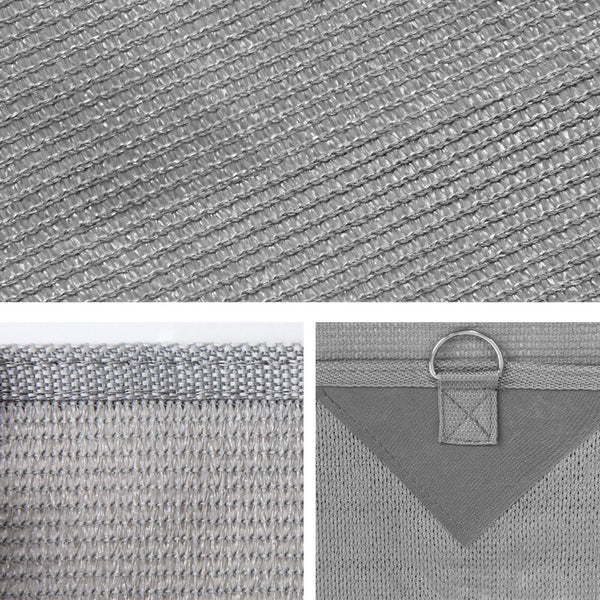
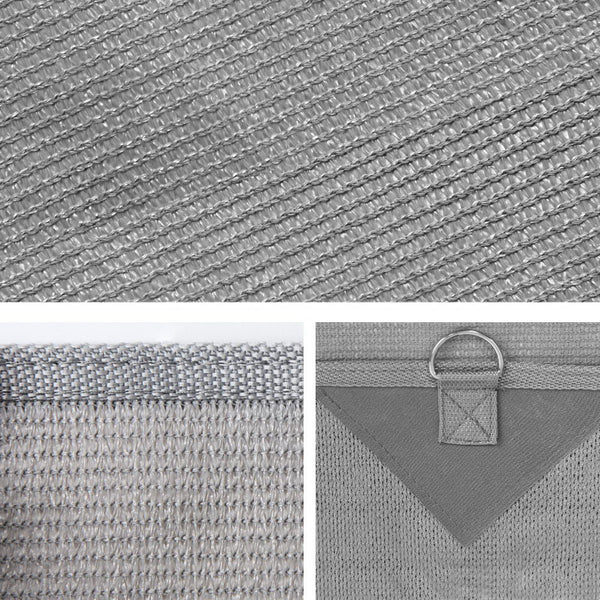
- Privacy screens slide into or hang from the awning's front edge or end, then peg out with guy ropes. The Weisshorn and Bariloche screens use stainless D-rings at the fixing points. Most go up in a few minutes.
- The Coast wall kit can go on with telescopic poles or with a sail track fixed along the van wall. Sail track gives a neater, more draught-proof edge, but it means screwing a track to the body. Poles leave the van untouched.
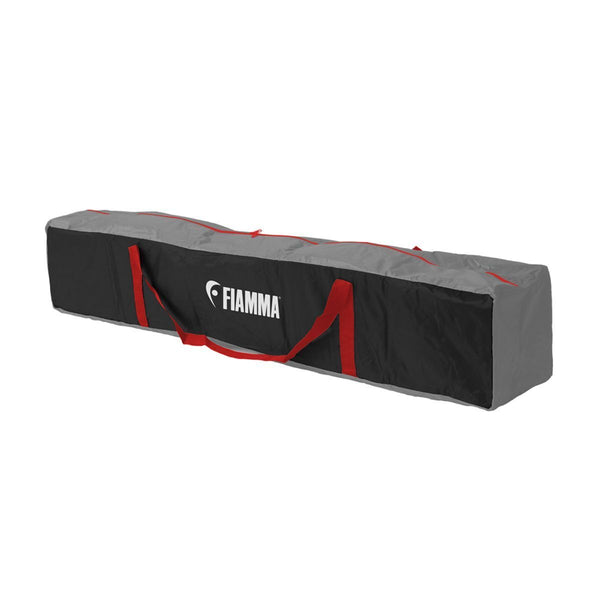
- Fiamma's Privacy Room uses Fiamma's Fast Clip system. Hinged aluminium profiles clamp the side panels to the awning canopy. The front panel slides into the awning's front rail and zips to the sides. A foam strip on the back edge of each side panel seals against the van wall. It packs into its own carry bag.
- End walls: left, right or either? Our Weisshorn end wall is reversible and straps to the awning arm, so one design covers the left or right end and you can buy two for both. Wall kits and full annexes are different: an end wall may be "handed", with its zips or door on one side only. If the end walls are interchangeable, you can swap them over to put the door where you want it. If they aren't, order the side you need. On the Fiamma room, the door in the front panel can be moved from left to right.
- Drive-away awnings connect with a kador strip slid into a rail on the vehicle, or with straps over the roof. A Figure 8 joiner lets you unhook the tunnel and drive off. Vango's 3 m drive-away kit includes the kador strip and joiner.
6. Anti-flap kits and rafter clamps
An anti-flap kit holds a roll-out awning's fabric down onto its arms so the roof can't lift and slap in the wind. Kits are usually a set of clamps that grip the fabric to each rafter arm, sometimes with tension straps or a stiffener along the front. With walls hanging from the awning, they do two jobs: they stop the roof drumming through a windy night, and they keep the top edge of each wall straight, so zips and channels aren't pulled out of line.
- Do you need one? For screens on a calm site, usually not. For a closed room left up for a week, or anywhere breezy, they make a real difference. Most annex trouble starts with a loose, flapping roof.
- They are model-specific. Clamps are made for a particular awning brand and arm shape, so match the kit to the awning (Dometic, Carefree and others differ), not to the annex.
- Check them against your walls. Some wall kits fix to the same rafter arms or channel that the clamps use. Confirm the two work together before you buy either.
- Cassette awnings such as Fiamma's use their maker's own rafters and fittings, so a generic roll-out anti-flap kit won't apply.
We don't sell anti-flap kits at the moment. Buy one made for your awning model from the awning's maker or a caravan accessory store. The related hardware we do stock is the Dometic zip track awning wall bracket kit, which fixes zip-track side walls to the van body on Dometic zip-track roll-out awnings. Confirm your awning model before you order it.
7. Keeping it tight in wind and rain
An annex turns an open awning into a sail. Most damage happens in the first gusty afternoon, not over years of use. A few habits prevent it:
- Tension the awning first. Pitch the awning properly, with its rafters tight, before any walls go on. Sagging fabric collects water and flaps against the walls. On a roll-out awning, rafter clamps or an anti-flap kit keep it that way.
- Drop one end for runoff. Set the awning slightly lower at one corner so rain runs off instead of pooling.
- Peg everything. Use every peg point and guy rope supplied. On sand or hard ground, carry longer pegs or sand bags for the legs.
- Close the walls on the windward side last, and open them first. A fully closed room has less flex than an open awning, but one open door on the windward side can lift the whole thing.
- Take it down before a storm. No annex or awning is built to ride out a storm warning. If strong winds are forecast, roll it up, and never leave it up while you're away from camp in doubtful weather.
- Pack it dry. Canvas and polyester walls packed wet will grow mildew within days. If you have to leave in the rain, unpack and dry them at the next stop.
8. Fabrics, windows and doors
Each type is made from a different material, and that decides what it is good at.
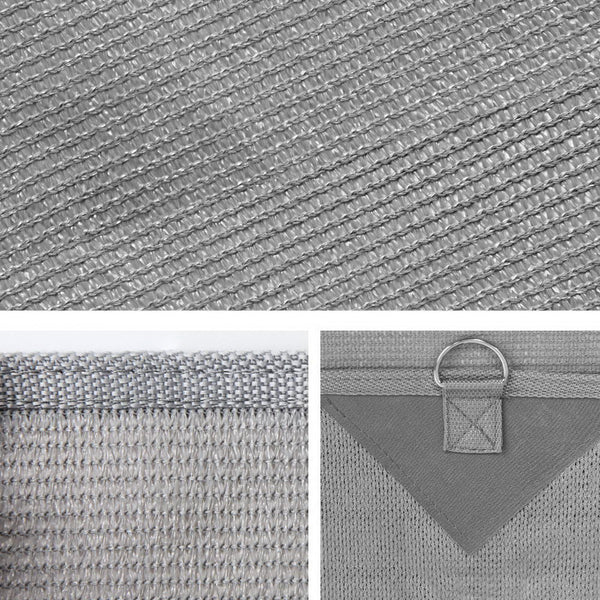
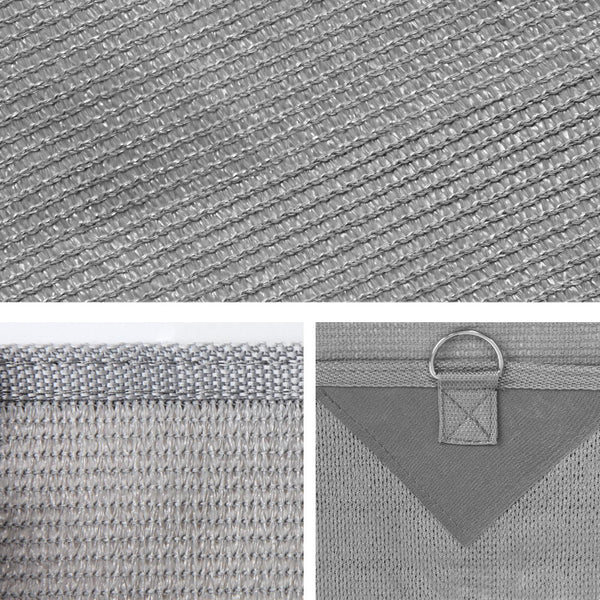
- Shade mesh (knitted polyethylene). Used in privacy screens. Our screens are 166 to 200 gsm, with a 95% shade rating. Air moves through it, so it stays cooler than a solid wall in summer. It is water-repellent but not waterproof, and it won't stop mozzies.
- Woven polyester. Used in the Coast wall kit. It is light for its strength, washes easily and dries fast, which suits people who pack up every few days.
- Solid, rain-proof panels. Privacy rooms and full annexes use solid wall fabric rather than mesh, so they keep out rain and wind as well as eyes. That suits colder, wetter trips, but walls this solid need their windows open in summer.
- Canvas. The traditional choice for made-to-measure annexes. It breathes, stays cooler and is quieter in wind. It is heavier, slower to dry, and must be fully dry before it is stored.
Windows. Look for windows with three layers you can use separately: a solid outer flap for privacy, clear PVC for light when it's raining, and flyscreen for air without insects. The Coast kit has all three. Fiamma's panels have roll-up clear Crystal windows with mosquito mesh and curtains.
Doors. A door in more than one wall lets you choose which side faces the campsite road or the view. The Coast kit has a door in each of its three walls. On the Fiamma room, the door can be moved from the left to the right of the front panel.
9. Sunrooms: an annex built for light
"Caravan sunroom" is the name people use for an annex with big clear windows on most of its walls. It is the same set of walls, chosen and pitched for light. In winter you sit in the sun out of a cold wind, with no flies. In summer you roll the clear panels up so the mesh behind them lets the breeze through.
- Getting one from our range. Fiamma's Privacy Room has roll-up clear Crystal windows backed by mosquito mesh and curtains. The Coast wall kit's windows include a clear PVC layer as well as a privacy flap and flyscreen. Privacy screens are the opposite of a sunroom: they are for shade.
- Pitch for the sun. If you can choose your site in winter, put the awning side of the van facing north so the low sun reaches the windows.
- Watch the heat. Clear walls work like a glasshouse. On a warm day, open them to the mesh before the room gets hot, and never leave a pet shut in.
- Look after the clear PVC. Roll windows rather than folding them sharply, keep them clean, and dry them before packing, or they go cloudy and crack.
10. Floors, draught skirts and weight
Floor. Neither wall kits nor privacy rooms come with a floor. Most people lay annex matting, which lets sand and water fall through and lets grass breathe. Rules differ between caravan parks. Some ask for breathable mesh, some take shade cloth only, and a few allow no ground cover. Our annex matting size guide covers sizes and park rules. Shop annex floor matting or ground cover matting. Pick a mat about as long as the space you want covered. The grey Weisshorn 5 x 2.5 m mat is breathable foamed PVC, and the matting collections hold other lengths.
Draught skirt. The gap under the van lets wind and dust blow straight into the annex. A skirt closes it. The Coast kit includes a draught skirt and wheel cover in grey PVC. On a Fiamma setup, the skirt is a separate accessory.
Weight. Annexes are heavier than people expect. Fiamma lists the 300 Medium at 24.4 kg and the Large at 24.7 kg, before poles and matting. That all counts against your van's payload. Stow the bag low and as close to the axle as you can, because heavy gear at either end of the van changes how it tows.
11. Gas appliances and ventilation
This is the safety part, so read it even if you skip the rest. Many caravans vent the gas hot water system, the fridge flue or a heater out through the same wall that the annex closes in. Burning gas produces carbon monoxide. If those vents open into an enclosed annex, the gas can build up where people sit and sleep.
- Before you buy, find every vent and flue on the awning side of your van.
- If any sit inside the annex footprint, don't run those appliances with the annex closed, or leave clear openings next to them. That includes leaving the draught skirt off that section.
- Never use a gas heater, cooker or barbecue inside a closed annex.
- Fit a battery carbon monoxide alarm in the van and in any annex used for sleeping.
12. What people actually use an annex for
- A second bedroom. Kids or guests sleep in the annex, on stretchers or in an inner room. In a campervan, the Vango BR001 inner bedroom clips inside compatible Vango drive-away awnings and sleeps two.
- A wet-weather living room. Most families buy an annex after one rainy week of everyone shut inside the van.
- Dining and cooking space. A table out of the wind and flies. Keep any gas cooking outside the enclosed space or under an open awning (see section 11).
- A change room and mudroom. Wet towels, boots and beach gear stay out of the van.
- Storage. Bikes, chairs and the generator stay out of sight overnight.
- Dogs. A closed room keeps a dog contained and shaded next to the van, where parks allow pets.
- Winter sun, summer shade. Clear windows turn a closed room into a sunroom in winter. In summer, screens give shade and keep the breeze.
13. Which one should you buy?
- Weekenders who move every few days: screens. They pack small, go up in minutes and fix the two big complaints, sun and neighbours, for a small cost.
- Families on longer stays with a roll-out awning: a wall kit, plus a mat and an anti-flap kit. You get a closed room with flyscreens and a draught skirt, using the awning you already have. Wall kits are low-stock items, so order well before the trip.
- Motorhome or caravan with a Fiamma awning: the matching Privacy Room. Buy the size that matches your awning height, not the one with the lowest price.
- Campervans: a drive-away awning, so the van can still go to the shops. Inflatable models pitch fastest. Poled models such as the Faros III Low and the Cove III Poled Low cost less.
- Cold, wet or months on one site: a made-to-measure annex is worth the cost and the wait.
14. Stock, pre-orders and ordering the right model
Annex walls and privacy rooms are bulky, low-volume items made for one awning family, so nobody holds deep stock. We keep small numbers of the Coast wall kit, the Dometic zip track bracket kit and the Fiamma Ducato room, often a single unit. When one sells, its product page may show a pre-order message while we reorder from the supplier.
- Pre-order means it ships when the next stock lands. If a trip depends on it, ask us for an expected date before you order.
- Order early. Allow time to pitch it at home before the trip, so you find a missing part or a poor fit in the driveway, not at the campground.
- Made-to-measure annexes take longer again. They are sewn to order for your van, so confirm the wait when you order.
- Get the model right first. Before you order, confirm the awning's brand and model (usually on a label on the case or end cap), its length and its height off the ground. Fiamma makes different rooms for different awning families and heights. Our Medium and Large rooms carry different part numbers (08366A01 and 08366B01), and the Ducato room is a separate model again. An annex made for another awning won't fit, however close the size looks.
15. Buying second-hand
Used annexes come up for sale often, usually when people sell a van or change awnings. They can be good value if they actually fit. Before you hand over money:
- Get the awning length, reach and height it was used with, and compare them with your own measurements. An annex made for an 18 ft awning won't fit a 16 ft one.
- Pitch it, or have the seller pitch it. Check every zip, and look for mildew spots, brittle PVC windows and torn peg loops.
- Check that every pole, rafter, skirt and bag is there. Missing hardware can cost more than you saved.
- For a Fiamma room, ask for the part number. It tells you which awning family and height it was built for.
Our take
Most people looking for a caravan annex would be better served by walls for the awning they already own than by a full canvas annex. For a roll-out awning, start with screens: a front screen and two reversible end walls cost a small fraction of a wall kit, and you will soon know whether you want a fully closed room. If you do, step up to a wall kit with doors, flyscreened windows and a draught skirt, add an anti-flap kit for the awning, and order early, because wall kits are scarce. With a Fiamma awning, buy the Privacy Room made for it, and measure the height before you choose Medium or Large. For a campervan, a drive-away awning such as the Vango Faros III gives you the room and still lets you drive away. Whatever you buy, check where your gas appliances vent before you zip it shut.
For the wider picture on shade and shelter, read our guide to tarps, gazebos and awnings.
Caravan annex FAQs
What is an annex on a caravan?
An annex is a room made by closing in the space under the caravan's awning with walls. The awning forms the roof. Walls zip, clip or slide on, and the room adds living or sleeping space beside the van.
What is the difference between a caravan annex and an awning?
The awning is the roof that rolls or winds out from the side of the van. The annex is the walls that hang from it to make a closed room. You need an awning before you can fit an annex.
How much does a caravan annex cost?
Privacy screens start at about $50 each. Drive-away awnings for campervans run from about $650 to $1,800. An 18 ft awning wall kit is about $2,000, and a Fiamma Privacy Room is about $2,200 to $2,800. A made-to-measure canvas annex usually costs more than a wall kit.
How do you attach an annex to a caravan?
Most annexes hang from the awning and fix to the van wall with a sail track, telescopic poles or clamps, then peg to the ground. Fiamma rooms use the Fast Clip system and the awning's front rail. Campervan awnings connect with a kador strip in the vehicle's rail.
How do I measure my caravan for an annex?
Measure the awning length between the centres of its two arms, how far it reaches out from the van wall, and the height from the ground to the awning rail. Do it with the van level and the awning pitched as you normally use it.
Do I need an anti-flap kit for an annex?
Not for screens on a calm site. For a closed room on a roll-out awning that stays up for days, or on a windy site, an anti-flap kit or rafter clamps stop the roof flapping and keep the walls straight. Buy one made for your awning model and check it works with your wall kit.
Can you sleep in a caravan annex?
Yes, many families use the annex as a second bedroom. Make sure no gas appliance vents into the annex, fit a carbon monoxide alarm, and lay matting or a floor to keep out damp and insects.
Is an awning wall kit or a privacy room better?
It depends on your awning. Wall kits suit roll-out awnings sized in feet. Privacy rooms are built by the awning maker for its own cassette awnings, such as Fiamma's F45 and F80 families. Pick the one made for the awning you have.
Do caravan parks allow annexes and annex matting?
Most parks allow an annex on the site. Ground cover rules differ: some ask for breathable mesh matting, some take shade cloth only, and a few allow no ground cover. Check the park's rules before you lay a mat.
Can an annex end wall go on either end of the awning?
It depends on the wall. Our Weisshorn end wall is reversible, so it fits the left or right end. Some wall kits have handed end walls, with the zips or door on one side, so check before you order. Interchangeable walls can be swapped to put the door where you want it.
Why does an annex product say pre-order?
Annex walls and privacy rooms are low-volume items, and we often hold only one or two. When stock runs out, the product page can show pre-order while we restock. Ask us for an expected date if you need it for a trip.
Does an annex come with a floor?
Usually not. Wall kits and privacy rooms are sold without a floor, so most people add annex matting about 2.5 m wide, cut to the length of the awning.